Tuba Fingering Chart
This tuba fingering chart shows the valves for every note on BB♭ tuba, from low E to high F, for both 3-valve and 4-valve tubas. Tap a note to see the fingering and hear how it should sound.
Note
Open (no valves)
Open. The center of the tuba sound.
Keyboard of every note on this chart. Use the note list or arrow keys instead if you prefer.
Instrument type
Notes shown
Options
Play a scale
Alternate fingerings for F2
None in common use. Use the main fingering above.
All tuba fingerings (low E to high F)
Every note on one page. Tap a note to hear it and load it into the tool above. Black means pressed or covered.
Below low E (4 valves)B0–E♭1
Low registerE1–B1
Middle registerC2–B2
Upper registerC3–F4
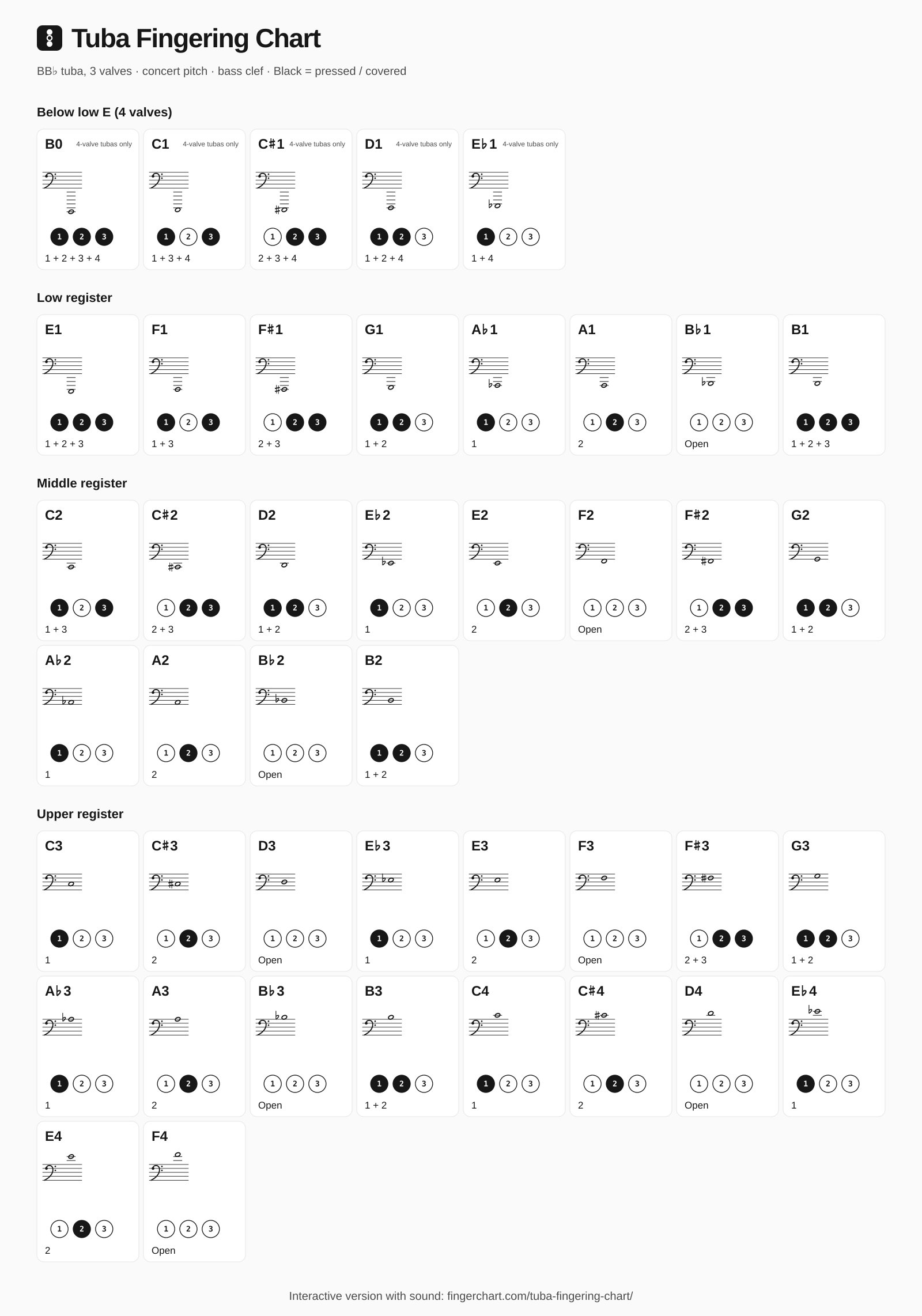
How to read this tuba fingering chart
Each box shows one note in bass clef and the valves to press. Filled circles are pressed down. “Open” means no valves. Tuba reads at concert pitch, so the note in the chart is the note you hear.
Every chart box shows the 3-valve fingering first. Where a 4-valve tuba does it differently, a second line shows the 4-valve fingering, for example “4-valve: 4” on low C.
Tuba notes for beginners
Most beginning tubists learn the concert B♭ scale first:
| Note | Valves | Tip |
|---|---|---|
| B♭ (low) | Open | Big, relaxed sound |
| C | 1 + 3 (or 4) | Sharp with 1+3; lip it down |
| D | 1 + 2 | |
| E♭ | 1 | |
| F | Open | Faster air than low B♭ |
| G | 1 + 2 | |
| A | 2 | |
| B♭ | Open | The octave |
Play each note long and steady. Then practice slurring between notes that share a fingering, like low B♭ and F, without moving your fingers.
4-valve tuba fingerings
A 4-valve tuba (sometimes called a 4 valve tuba with a “fourth valve”) adds a valve, worked by the right ring finger on most tubas (some models put it under the left hand). It lowers the pitch by a perfect fourth, the same amount as 1+3, but in tune. Players use it for:
- Low C and low F: 4 instead of 1+3.
- Low B and low E: 2+4 instead of 1+2+3.
- Below low E: E♭ (1+4), D (1+2+4), D♭ (2+3+4), C (1+3+4) and B (1+2+3+4). These run sharp on most non-compensating tubas, so listen and adjust.
Tuba note chart above the staff
Above middle C the partials get close together. Use faster, narrower air instead of more mouthpiece pressure, and build range with lip slurs on open and on 2nd valve. High F (F4) is the top of most school tuba parts.
Tuba Fingering Chart FAQ
What are the tuba notes for beginners?
Most band books start tuba players on the concert B♭ scale: B♭ (open), C (1+3, or 4), D (1+2), E♭ (1), F (open), G (1+2), A (2) and B♭ (open). Switch the tool to Beginner view to see just those notes.
What does the 4th valve on a tuba do?
The 4th valve lowers the pitch by a fourth. It replaces the out-of-tune 1+3 and 1+2+3 combinations (low C and F, low B and E) and lets you play notes below low E. Switch the tool to 4 valves to see those fingerings.
What is the lowest note on a tuba?
On a 3-valve BB♭ tuba the lowest regular note is the E below the bass clef staff (1+2+3). A 4-valve tuba continues down to low B, and below that are pedal tones.
Is a tuba fingering chart the same for sousaphone?
Yes. A BB♭ sousaphone uses the same 3-valve fingerings as a BB♭ tuba, so this chart works for sousaphone too. E♭ and CC tubas use different fingerings.
Why do some tuba notes have the same fingering?
Each valve combination plays a series of notes called partials. With no valves you can play B♭, F, B♭, D and F by changing your air speed and lip tension. That is why open appears several times on the chart.
Do I read bass clef on the tuba?
Yes. Tuba music is written in bass clef at concert pitch, so the note on the page is the note you hear. Notes far below the staff use ledger lines.
Related charts
Last updated .How we verify fingerings