Oboe Fingering Chart
This oboe fingering chart shows every note on the oboe from low B♭ to high F, including the half-hole notes and the forked, left and regular F. Tap a note to see the fingering and hear it.
Note
Left hand 1-2-3
Keyboard of every note on this chart. Use the note list or arrow keys instead if you prefer.
Notes shown
Options
Play a scale
Alternate fingerings for G4
None in common use. Use the main fingering above.
All oboe fingerings (low B♭ to high F)
Every note on one page. Tap a note to hear it and load it into the tool above. Black means pressed or covered.
Low registerB♭3–C♯5
- B♭3 / A♯3Left hand 1-2-3, right hand 1-2-3, left pinky low B♭ key and right pinky low C keyBeing checked
- B3Left hand 1-2-3, right hand 1-2-3, left pinky low B key and right pinky low C keyBeing checked
- C4Left hand 1-2-3, right hand 1-2-3 and right pinky low C key
- C♯4 / D♭4Left hand 1-2-3, right hand 1-2-3 and right pinky low C♯ key
- D4Left hand 1-2-3 and right hand 1-2-3
- E♭4 / D♯4Left hand 1-2-3, right hand 1-2-3 and right pinky E♭ keyAlt: Left hand 1-2-3, right hand 1-2-3 and left pinky E♭ key
- E4Left hand 1-2-3 and right hand 1-2
- F4Left hand 1-2-3 and right hand 3Alt: Left hand 1-2-3, right hand 1-3 and right pinky E♭ key; Left hand 1-2-3 and left F keyBeing checked
- F♯4 / G♭4Left hand 1-2-3 and right hand 2Being checked
- G4Left hand 1-2-3
- G♯4 / A♭4Left hand 1-2-3 and left pinky G♯ key
- A4Left hand 1-2
- B♭4 / A♯4Left hand 1 and right hand 1Being checked
- B4Left hand 1
- C5Left hand 1 and right hand 2-3Being checked
- C♯5 / D♭5Half-hole, left hand 2-3, right hand 1-2-3 and right pinky low C♯ key
Upper register (half-hole and octave keys)D5–C♯6
- D5Half-hole, left hand 2-3 and right hand 1-2-3
- E♭5 / D♯5Half-hole, left hand 2-3, right hand 1-2-3 and right pinky E♭ keyAlt: Half-hole, left hand 2-3, right hand 1-2-3 and left pinky E♭ key
- E5Thumb octave key, left hand 1-2-3 and right hand 1-2
- F5Thumb octave key, left hand 1-2-3 and right hand 3Alt: Thumb octave key, left hand 1-2-3, right hand 1-3 and right pinky E♭ keyBeing checked
- F♯5 / G♭5Thumb octave key, left hand 1-2-3 and right hand 2Being checked
- G5Thumb octave key and left hand 1-2-3
- G♯5 / A♭5Thumb octave key, left hand 1-2-3 and left pinky G♯ key
- A5Side (second) octave key and left hand 1-2
- B♭5 / A♯5Side (second) octave key, left hand 1 and right hand 1Being checked
- B5Side (second) octave key and left hand 1
- C6Side (second) octave key, left hand 1 and right hand 2-3Being checked
- C♯6 / D♭6Half-hole, left hand 2-3, right hand 1-2 and right pinky low C♯ keyBeing checked
High registerD6–F6
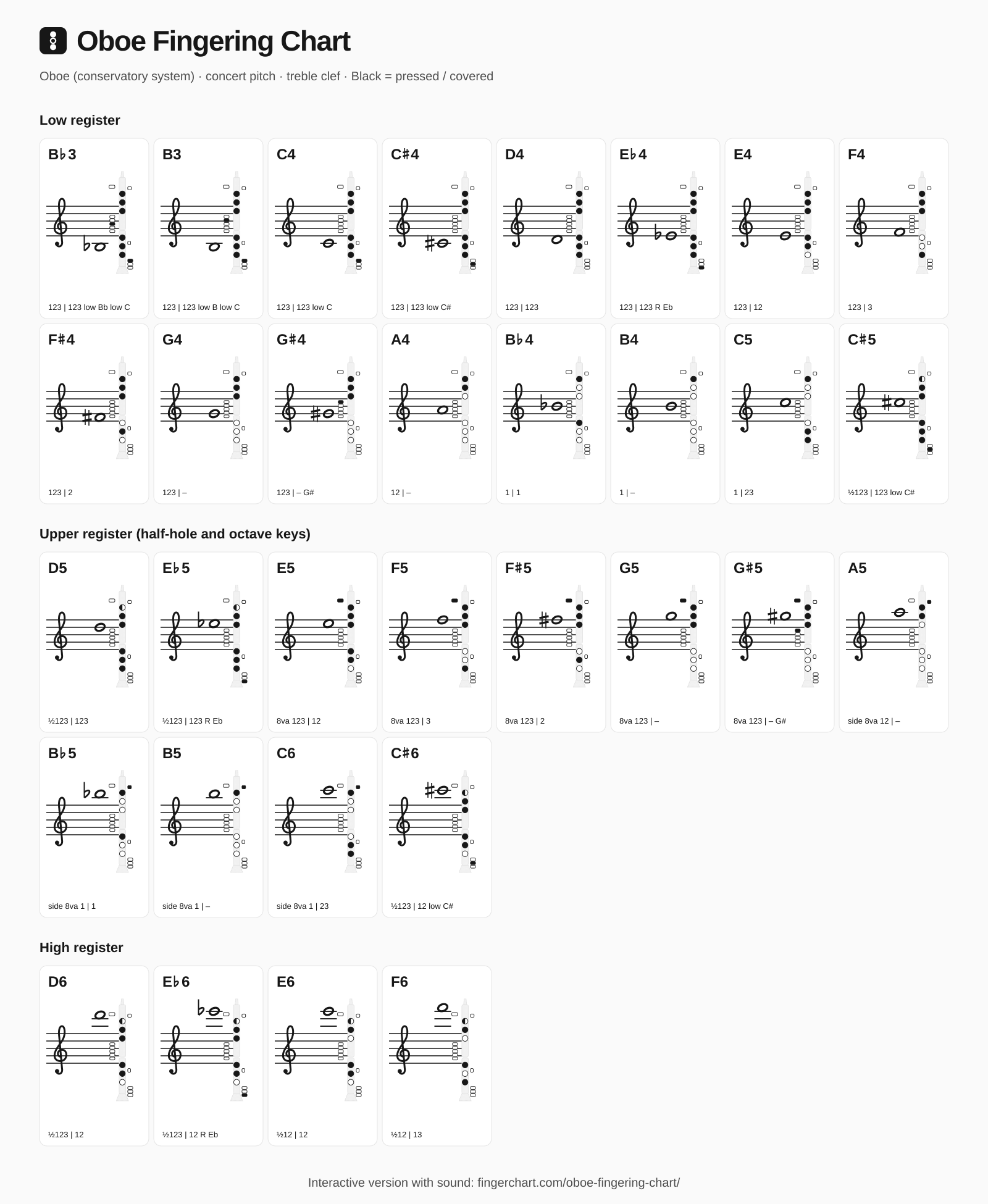
How to read this oboe fingering chart
The diagram is a front view with the reed at the top.
- Circles are the six main holes, left hand on top. The top-left circle shows a half-hole when only its left half is filled.
- The thumb octave key (marked 8) is drawn on the left; the side octave key is the small key on the right at the top.
- Left pinky keys (G♯, low B, low B♭, E♭ and left F) are drawn on the left; right pinky keys (low C, C♯, E♭) are at the bottom right. The small key beside right 1 is the F resonance key.
Oboe reads treble clef at concert pitch.
Several oboe entries are marked Being checked while an oboist reviews them. Oboes differ more than most woodwinds (full conservatory, modified conservatory and student models have different keys), so match the chart to your own instrument and ask your teacher about any key you don’t have.
Oboe F fingerings
The oboe has three ways to play F:
- Regular (right) F: the standard choice whenever your fingers allow it.
- Forked F: for passages where F follows E♭ or D quickly. Slightly veiled tone.
- Left F: on full-conservatory oboes only. Same tone as regular F, handy when the right pinky is busy.
Turn on Alternates in the tool to compare them.
Half-hole and octave keys
From second-octave C♯ to E♭ you half-hole: roll the left index finger so the small vent opens. From E to G♯ you use the thumb octave key, and from A up the side octave key. Practice moving between them slowly; it is the oboe’s version of crossing the break.
Oboe Fingering Chart FAQ
What is the half-hole on the oboe?
The left index finger key has a small vent. Rolling the finger down so the vent is open (the half-hole) makes the second-octave C♯, D and E♭ speak without the octave key.
What is forked F on the oboe?
Forked F is an F fingering that leaves a gap between fingers, like a fork. It is useful when F comes right after E♭ or D, but its tone is slightly veiled, so use the regular or left F when you can.
What are the two octave keys on the oboe?
The thumb octave key is used for second-octave notes from E to G♯. From A upward most oboists use the side (second) octave key, pressed with the side of the left index finger.
What notes should a beginner oboe player learn first?
Most beginners start with G, A and B in the staff (left 1-2-3, 1-2 and 1), then C and D. The low notes and the half-hole notes come next.
Why does my oboe squeak or not play low notes?
Low notes on the oboe need a well-sealed instrument and a reed that is not too hard. Check that every pad closes and that your fingers cover the rings completely.
Related charts
Last updated .How we verify fingerings