Piccolo Fingering Chart
This piccolo fingering chart shows the keys for every note on the C piccolo, from low D to high B♭. Tap a note to see the fingering and hear it an octave higher than written, the way a piccolo really sounds.
Written note
Sounds A5 (concert)
Left thumb (B key), left hand 1-2 and right pinky E♭ key
Same fingering as flute A. On piccolo it sounds A5, an octave higher.
Keyboard of every note on this chart. Use the note list or arrow keys instead if you prefer.
Notes shown
Note names
Options
Play a scale
Alternate fingerings for A4
None in common use. Use the main fingering above.
All piccolo fingerings (low D to high B♭)
Every note on one page. Tap a note to hear it and load it into the tool above. Black means pressed or covered.
Low register (first octave)D4–C♯5
- D4concert D5Left thumb (B key), left hand 1-2-3 and right hand 1-2-3
- E♭4 / D♯4concert E♭5Left thumb (B key), left hand 1-2-3, right hand 1-2-3 and right pinky E♭ key
- E4concert E5Left thumb (B key), left hand 1-2-3, right hand 1-2 and right pinky E♭ key
- F4concert F5Left thumb (B key), left hand 1-2-3, right hand 1 and right pinky E♭ key
- F♯4 / G♭4concert F♯5Left thumb (B key), left hand 1-2-3, right hand 3 and right pinky E♭ key
- G4concert G5Left thumb (B key), left hand 1-2-3 and right pinky E♭ key
- G♯4 / A♭4concert G♯5Left thumb (B key), left hand 1-2-3, left pinky G♯ key and right pinky E♭ key
- A4concert A5Left thumb (B key), left hand 1-2 and right pinky E♭ key
- B♭4 / A♯4concert B♭5Left thumb on the B♭ lever, left hand 1 and right pinky E♭ keyAlt: Left thumb (B key), left hand 1, right hand 1 and right pinky E♭ key
- B4concert B5Left thumb (B key), left hand 1 and right pinky E♭ key
- C5concert C6Left hand 1 and right pinky E♭ key
- C♯5 / D♭5concert C♯6Right pinky E♭ key
Middle register (second octave)D5–C♯6
- D5concert D6Left thumb (B key), left hand 2-3 and right hand 1-2-3
- E♭5 / D♯5concert E♭6Left thumb (B key), left hand 2-3, right hand 1-2-3 and right pinky E♭ key
- E5concert E6Left thumb (B key), left hand 1-2-3, right hand 1-2 and right pinky E♭ key
- F5concert F6Left thumb (B key), left hand 1-2-3, right hand 1 and right pinky E♭ key
- F♯5 / G♭5concert F♯6Left thumb (B key), left hand 1-2-3, right hand 3 and right pinky E♭ key
- G5concert G6Left thumb (B key), left hand 1-2-3 and right pinky E♭ key
- G♯5 / A♭5concert G♯6Left thumb (B key), left hand 1-2-3, left pinky G♯ key and right pinky E♭ key
- A5concert A6Left thumb (B key), left hand 1-2 and right pinky E♭ key
- B♭5 / A♯5concert B♭6Left thumb on the B♭ lever, left hand 1 and right pinky E♭ keyAlt: Left thumb (B key), left hand 1, right hand 1 and right pinky E♭ key
- B5concert B6Left thumb (B key), left hand 1 and right pinky E♭ key
- C6concert C7Left hand 1 and right pinky E♭ key
- C♯6 / D♭6concert C♯7Right pinky E♭ key
High register (third octave)D6–B♭6
- D6concert D7Left thumb (B key), left hand 1-2, right hand 1-2-3 and right pinky E♭ key
- E♭6 / D♯6concert E♭7Left thumb (B key), left hand 1-2-3, right hand 1-2-3, left pinky G♯ key and right pinky E♭ key
- E6concert E7Left thumb (B key), left hand 1-2, right hand 1-2 and right pinky E♭ key
- F6concert F7Left thumb (B key), left hand 1-3, right hand 1 and right pinky E♭ key
- F♯6 / G♭6concert F♯7Left thumb (B key), left hand 1-3, right hand 3 and right pinky E♭ key
- G6concert G7Left hand 1-2-3 and right pinky E♭ key
- G♯6 / A♭6concert G♯7Left hand 2-3, left pinky G♯ key and right pinky E♭ key
- A6concert A7Left thumb (B key), left hand 2, right hand 1 and right pinky E♭ key
- B♭6 / A♯6concert B♭7Left thumb (B key), left hand 1, right hand 1 and right pinky E♭ key
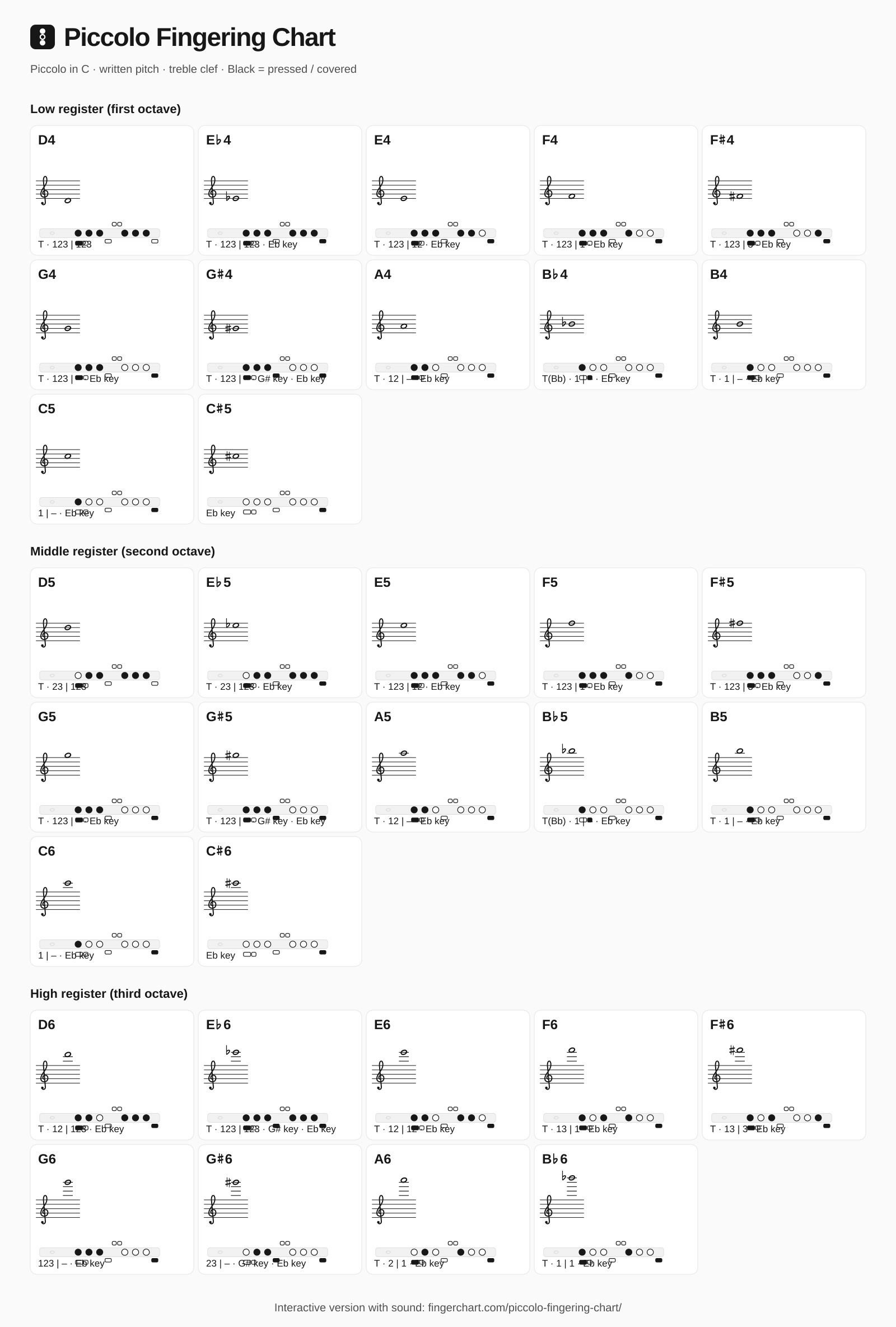
How to read this piccolo fingering chart
Each box shows the written note in treble clef and a picture of the piccolo seen from the front, head joint on the left. Black means pressed or covered. “T” is the left thumb key; “T(B♭)” is the thumb on the B♭ lever. The text under each picture lists the fingers left hand first.
The piccolo transposes up an octave. A note in the second space of the staff (written A4) sounds A5, so the “Hear it” button in the tool plays it an octave above the page.
Piccolo vs flute fingerings
If you play flute you already know these fingerings. Three things change:
- No foot joint. The piccolo stops at low D. Without the low C and C♯ rollers, the right pinky only works the E♭ key.
- Smaller everything. Use a smaller aperture, faster air and less lip coverage than on flute. Pushing harder makes it sharp; firm, fast air keeps it centred.
- Third-octave alternates. Many players use special fingerings above high D to correct sharp or stuffy notes. The high-register boxes show the standard flute fingerings; ask your teacher which alternates suit your piccolo.
Piccolo notes for beginners
Start in the middle of the range, where the piccolo speaks most easily: written G4 up to G5. The second octave uses the same fingerings as the first, with slightly faster air (except D and E♭, which lift the left index finger). Switch the tool to Beginner view to see only these notes.
Playing the piccolo in tune
Pull the head joint out a few millimetres to start, then tune to the band’s concert A or B♭. Check the low register and the top of the second octave as well as the tuning note: the piccolo’s scale is less even than the flute’s, so you will lip some notes up or down even after the head joint is set. The piccolo tuner shows notes in written pitch, so you can read it the same way as this chart.
Teachers: link to this chart
Add it to your band website, class page or library guide. It is free to link to, with no sign-up.
Piccolo Fingering Chart FAQ
Are piccolo fingerings the same as flute fingerings?
Almost. The C piccolo uses the same Boehm fingerings as the flute for the first two octaves, so a flutist can read this chart straight away. The differences are at the very bottom (no low C or C♯) and in the third octave, where piccolo players often choose alternates for tuning.
What is the lowest note on a piccolo?
Written D just above middle C (D4). A piccolo has no foot joint, so there is no low C or C♯. The low D sounds D5 and is soft on most instruments.
Does the piccolo sound an octave higher than written?
Yes. Piccolo music is written in treble clef an octave below the sound, so it doesn't need lots of ledger lines. Written A4 sounds A5. The tool plays every note at the pitch you will actually hear.
Why is the piccolo so hard to play in tune?
The piccolo is half the length of a flute, so tiny changes in air speed, lip coverage and how far the head joint is pulled out move the pitch a lot. Practice long tones with a tuner and listen down to the flutes below you.
How high can a piccolo play?
The standard range tops out at written high C (C7), which sounds C8, the top note of a piano. This chart currently goes to high B♭; the top two notes are being checked with a piccolo player before they are added.
Should a beginner start on piccolo or flute?
Flute first. Band directors usually move flutists to piccolo once they have a steady tone and the second octave is reliable, because the piccolo exaggerates every embouchure problem.
Related charts
Last updated .How we verify fingerings