Bass Clarinet Fingering Chart
This bass clarinet fingering chart covers every note from the low C extension up to high C, for both low E♭ and low C bass clarinets. Tap a note to see the fingering and hear it at concert pitch.
Written note
Sounds F3 (concert)
Open: no keys or holes
Throat tones are weak on bass clarinet. Many players add right-hand fingers for a fuller sound.
Keyboard of every note on this chart. Use the note list or arrow keys instead if you prefer.
Instrument type
Notes shown
Note names
Options
Play a scale
Alternate fingerings for G4
None in common use. Use the main fingering above.
All bass clarinet fingerings (low C to high C)
Every note on one page. Tap a note to hear it and load it into the tool above. Black means pressed or covered.
Low extension (below low E)C3–E♭3
- C3concert B♭1Thumb hole, left hand 1-2-3, right hand 1-2-3 and low C keyBeing checked
- C♯3 / D♭3concert B1Thumb hole, left hand 1-2-3, right hand 1-2-3 and low C♯ keyBeing checked
- D3concert C2Thumb hole, left hand 1-2-3, right hand 1-2-3 and low D keyBeing checked
- E♭3 / D♯3concert D♭2Thumb hole, left hand 1-2-3, right hand 1-2-3 and low E♭ keyBeing checked
Low (chalumeau) registerE3–F♯4
- E3concert D2Thumb hole, left hand 1-2-3, right hand 1-2-3 and left pinky E/B keyAlt: Thumb hole, left hand 1-2-3, right hand 1-2-3 and right pinky E/B key
- F3concert E♭2Thumb hole, left hand 1-2-3, right hand 1-2-3 and right pinky F/C keyAlt: Thumb hole, left hand 1-2-3, right hand 1-2-3 and left pinky F/C key
- F♯3 / G♭3concert E2Thumb hole, left hand 1-2-3, right hand 1-2-3 and left pinky F♯/C♯ keyAlt: Thumb hole, left hand 1-2-3, right hand 1-2-3 and right pinky F♯/C♯ key
- G3concert F2Thumb hole, left hand 1-2-3 and right hand 1-2-3
- G♯3 / A♭3concert F♯2Thumb hole, left hand 1-2-3, right hand 1-2-3 and right pinky A♭/E♭ key
- A3concert G2Thumb hole, left hand 1-2-3 and right hand 1-2
- B♭3 / A♯3concert A♭2Thumb hole, left hand 1-2-3 and right hand 1Being checked
- B3concert A2Thumb hole, left hand 1-2-3 and B/F♯ sliver keyBeing checked
- C4concert B♭2Thumb hole and left hand 1-2-3
- C♯4 / D♭4concert B2Thumb hole, left hand 1-2-3 and left pinky C♯/G♯ key
- D4concert C3Thumb hole and left hand 1-2
- E♭4 / D♯4concert D♭3Thumb hole, left hand 1 and E♭/B♭ sliver keyBeing checked
- E4concert D3Thumb hole and left hand 1
- F4concert E♭3Thumb hole
- F♯4 / G♭4concert E3Left hand 1
Throat tonesG4–B♭4
Upper (clarion) registerB4–C6
- B4concert A3Thumb hole, register key, left hand 1-2-3, right hand 1-2-3 and left pinky E/B keyAlt: Thumb hole, register key, left hand 1-2-3, right hand 1-2-3 and right pinky E/B key
- C5concert B♭3Thumb hole, register key, left hand 1-2-3, right hand 1-2-3 and right pinky F/C keyAlt: Thumb hole, register key, left hand 1-2-3, right hand 1-2-3 and left pinky F/C key
- C♯5 / D♭5concert B3Thumb hole, register key, left hand 1-2-3, right hand 1-2-3 and left pinky F♯/C♯ keyAlt: Thumb hole, register key, left hand 1-2-3, right hand 1-2-3 and right pinky F♯/C♯ key
- D5concert C4Thumb hole, register key, left hand 1-2-3 and right hand 1-2-3
- E♭5 / D♯5concert D♭4Thumb hole, register key, left hand 1-2-3, right hand 1-2-3 and right pinky A♭/E♭ key
- E5concert D4Thumb hole, register key, left hand 1-2-3 and right hand 1-2
- F5concert E♭4Thumb hole, register key, left hand 1-2-3 and right hand 1Being checked
- F♯5 / G♭5concert E4Thumb hole, register key, left hand 1-2-3 and B/F♯ sliver keyBeing checked
- G5concert F4Thumb hole, register key and left hand 1-2-3
- G♯5 / A♭5concert F♯4Thumb hole, register key, left hand 1-2-3 and left pinky C♯/G♯ key
- A5concert G4Thumb hole, register key and left hand 1-2
- B♭5 / A♯5concert A♭4Thumb hole, register key, left hand 1 and E♭/B♭ sliver keyBeing checked
- B5concert A4Thumb hole, register key and left hand 1
- C6concert B♭4Thumb hole and register key
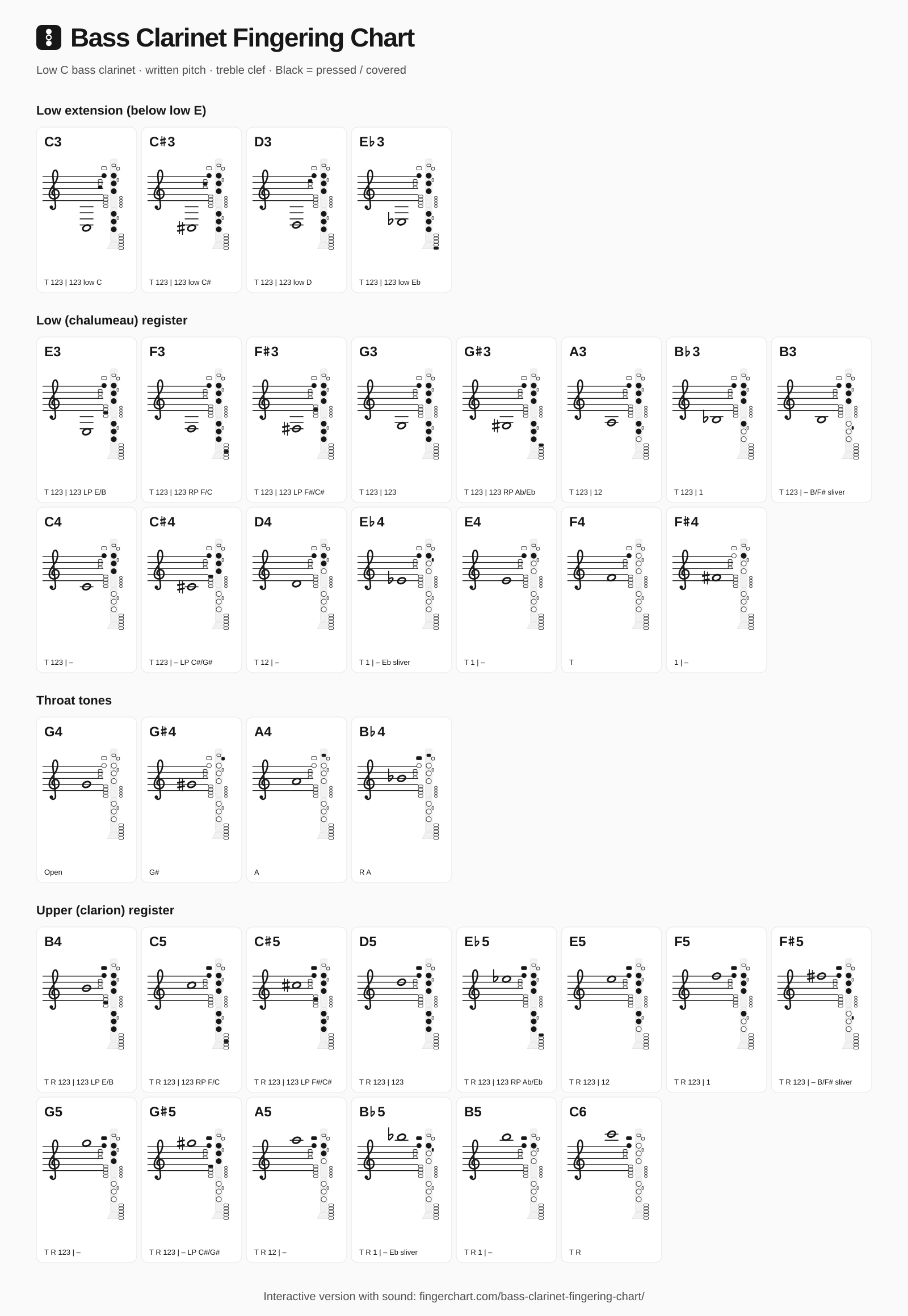
How to read this bass clarinet fingering chart
The diagram is a front view with the mouthpiece at the top. Circles are tone holes (filled means covered), and the thumb hole (T) and register key (R) are drawn on the left because they sit on the back. The keys to the far left are the low extension keys worked by the left thumb, and the extra key at the bottom right is the low E♭ key.
The notes are written pitch in treble clef, which is how most band parts are printed. The “concert” label shows the sound, a major ninth lower.
Fingerings marked Being checked are waiting for review by a bass clarinetist. The low extension keys are laid out differently by different makers, so match the chart to your own instrument and ask your director if a key is in a different spot.
Low C extension
School bass clarinets usually go down to written low E♭. Professional and many newer instruments add the low C extension: written low D, C♯ and C. On most low C instruments those keys are worked by the left thumb, with low E♭ on the right pinky or left thumb depending on the model.
Low notes need slow, warm air and a relaxed jaw. If a low note won’t speak, check for leaks first; the low extension pads are large and easy to knock out of adjustment.
Bass clarinet vs B♭ clarinet fingerings
From low E up to high C, the written fingerings match the B♭ clarinet, including the register key, throat tones and pinky alternates. What changes:
- Below low E you have the extension keys described above.
- Throat tones (G, A and B♭ in the staff) can sound thin. Many players add right-hand fingers for a fuller tone; your teacher will show you which ones suit your instrument.
- Above high C bass clarinet uses its own altissimo fingerings, which this chart does not cover yet.
The break on bass clarinet
Modern bass clarinets have an automatic register mechanism, so one register key works across the break. Some older instruments have two register keys or need the left first finger to half-cover its hole for high notes. If your instrument has two register keys, ask your director which notes use the second one.
Keep the air fast and supported when you cross from B♭ to B. Bass clarinet notes in the clarion register need more air than you expect, not more pressure from the jaw.
Bass Clarinet Fingering Chart FAQ
Are bass clarinet fingerings the same as clarinet?
From low E up to high C, yes. A bass clarinet uses the same written fingerings as a B♭ clarinet, so if you already play clarinet you can read this chart right away. The differences are the extra low keys and the notes above high C.
What is the lowest note on a bass clarinet?
It depends on the model. Many school bass clarinets go down to written low E♭. Low C bass clarinets have extra keys that reach written low D, C♯ and C. Use the Instrument type switch in the tool to match your instrument.
What key is the bass clarinet in?
The bass clarinet is in B♭. Band parts are usually written in treble clef and sound a major ninth lower than written (an octave plus a whole step). Written C sounds as the B♭ more than an octave below.
Why is it hard to get notes over the break on bass clarinet?
The bass clarinet needs more air and a more open throat than the B♭ clarinet. Use slow, warm, fast-moving air, keep the jaw steady, and check that the neck is angled so the mouthpiece meets your mouth without biting.
What does the low C extension add?
It adds keys for written low E♭, D, C♯ and C, below the clarinet's low E. Those notes sound as concert D♭ down to concert B♭, which lets the bass clarinet double the tuba and string bass lines.
Why does my bass clarinet squeak?
The big tone holes and long body leak easily. Cover holes with the flat pads of your fingers, check that the pads seal, and make sure the bridge keys between the upper and lower joints line up.
Related charts
Last updated .How we verify fingerings