Sousaphone Fingering Chart
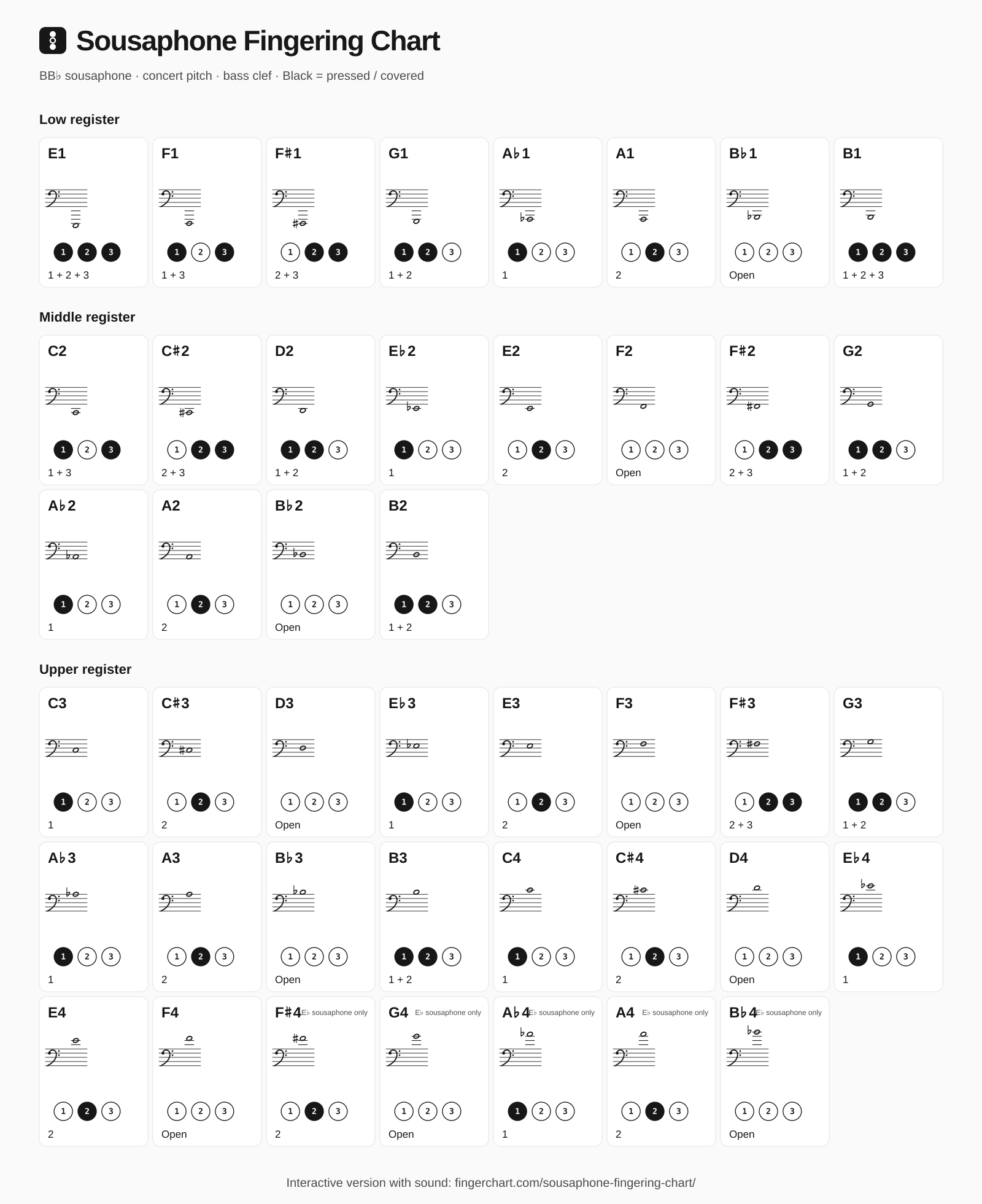
This sousaphone fingering chart shows the valves for every note on BB♭ and E♭ sousaphone, from low E up to high B♭. Tap a note to see which valves to press and hear how it should sound.
Note
Open (no valves)
Open on a BB♭ sousaphone: the big, low note most marching tubas start on.
Keyboard of every note on this chart. Use the note list or arrow keys instead if you prefer.
Instrument type
Notes shown
Options
Play a scale
Alternate fingerings for B♭1
None in common use. Use the main fingering above.
All sousaphone fingerings (low E to high B♭)
Every note on one page. Tap a note to hear it and load it into the tool above. Black means pressed or covered.
Low registerE1–B1
Middle registerC2–B2
Upper registerC3–B♭4
- C31E♭ sousaphone: 1 + 2Alt: 1 + 3
- C♯3 / D♭32E♭ sousaphone: 1Alt: 2 + 3
- D3OpenE♭ sousaphone: 2Alt: 1 + 2
- E♭3 / D♯31E♭ sousaphone: Open
- E32E♭ sousaphone: 1 + 2
- F3OpenE♭ sousaphone: 1Alt: 1 + 3
- F♯3 / G♭32 + 3E♭ sousaphone: 2
- G31 + 2E♭ sousaphone: OpenAlt: 3
- A♭3 / G♯31
- A32
- B♭3 / A♯3OpenE♭ sousaphone: 1 + 3
- B31 + 2E♭ sousaphone: 2 + 3
- C41E♭ sousaphone: 1 + 2
- C♯4 / D♭42E♭ sousaphone: 1
- D4OpenE♭ sousaphone: 2Alt: 1 + 2
- E♭4 / D♯41E♭ sousaphone: Open
- E42E♭ sousaphone: 1 + 2
- F4OpenE♭ sousaphone: 1
- F♯4 / G♭42E♭ sousaphone only
- G4OpenE♭ sousaphone: 1 + 2E♭ sousaphone only
- A♭4 / G♯41E♭ sousaphone only
- A42E♭ sousaphone only
- B♭4 / A♯4OpenE♭ sousaphone only
How to read this sousaphone fingering chart
Each box shows one note in bass clef and the three valves seen from above. Filled circles are pressed down. “Open” means no valves.
The chart lists the BB♭ sousaphone fingering first. Where an E♭ sousaphone uses a different fingering, a second line shows it, for example “E♭ sousaphone: 1 + 3” on low B♭. A few low notes only exist on BB♭ and a few high notes are only charted for E♭; those boxes are labelled.
BB♭ vs E♭ sousaphone
Almost every school and marching band sousaphone is a BB♭ sousaphone. It has the same tubing length as a BB♭ tuba, so it shares the tuba’s fingerings note for note, and you can switch between the two instruments without relearning anything.
The E♭ sousaphone is smaller and sits a perfect fourth higher. Its open notes are E♭ and B♭ instead of B♭ and F, so each valve combination plays a different note. Both instruments read the same bass-clef parts at concert pitch; only the fingerings change.
Sousaphone notes for beginners
| Note | BB♭ sousaphone | E♭ sousaphone |
|---|---|---|
| B♭ (low) | Open | 1 + 3 |
| C | 1 + 3 | 1 + 2 |
| D | 1 + 2 | 2 |
| E♭ | 1 | Open |
| F | Open | 1 + 3 |
| G | 1 + 2 | 1 + 2 |
| A | 2 | 2 |
| B♭ | Open | Open |
Playing sousaphone on the march
The sousaphone wraps around your body so you can march with it, and the bell points forward over your head. Keep the mouthpiece at your lips rather than leaning your head down to it, and support the weight on your left shoulder so your right hand stays free for the valves. Breathe from low in your body: the sousaphone needs as much air as a tuba, and marching makes that harder.
Teachers: link to this chart
Add it to your band website, class page or library guide. It is free to link to, with no sign-up.
Sousaphone Fingering Chart FAQ
Is sousaphone fingering the same as tuba?
For a BB♭ sousaphone, yes: it uses exactly the same 3-valve fingerings as a BB♭ tuba. An E♭ sousaphone is pitched a fourth higher, so the same written note takes a different fingering. Switch the tool to E♭ sousaphone to see those.
How do I know if my sousaphone is BB♭ or E♭?
Play with no valves pressed and check the note on a tuner. If the open notes are B♭ and F, it is a BB♭ sousaphone (by far the most common). If they are E♭ and B♭, it is an E♭ sousaphone. BB♭ sousaphones are also noticeably larger.
What clef does the sousaphone read?
Bass clef at concert pitch, the same parts as the tuba. The note on the page is the note you hear, so there is no transposition to work out.
What are the first sousaphone notes to learn?
On a BB♭ sousaphone, start with the concert B♭ scale: B♭ (open), C (1+3), D (1+2), E♭ (1), F (open), G (1+2), A (2) and B♭ (open). Switch the tool to Beginner view to see these notes.
What is the lowest note on a sousaphone?
On a 3-valve BB♭ sousaphone the lowest regular note is low E below the bass clef staff (1+2+3). Sousaphones don't have a 4th valve, so notes below that are pedal tones.
Why does my low C sound sharp on the sousaphone?
On a 3-valve brass instrument, valve combinations like 1+3 and 1+2+3 are naturally sharp. Use a relaxed, open sound and lip the note down, or pull the third-valve slide if your sousaphone has one you can reach.
Related charts
Last updated .How we verify fingerings