Bass Trombone Slide Chart
This bass trombone slide chart shows the slide position and valve for every note from pedal B♭ to high B♭, for single-valve and double-valve bass trombones. Tap a note to see where the slide goes and hear the note.
Note
F trigger, 1st position
F valve, 1st position: the home note of the bass trombone's low register.
Keyboard of every note on this chart. Use the note list or arrow keys instead if you prefer.
Instrument
Notes shown
Options
Play a scale
Alternate fingerings for F2
6th position
All bass trombone positions (pedal B♭ to high B♭)
Every note on one page. Tap a note to hear it and load it into the tool above. Black means pressed or covered.
Valve registerB♭1–E2
Low registerF2–F3
- F2F trigger, 1st positionAlt: 6th position
- F♯2 / G♭25th position
- G24th position
- A♭2 / G♯23rd position
- A22nd position
- B♭2 / A♯21st position
- B27th positionAlt: F trigger, 2nd position
- C36th positionAlt: F trigger, 1st position
- C♯3 / D♭35th position
- D34th position
- E♭3 / D♯33rd position
- E32nd position
- F31st position
Upper registerF♯3–B♭4
- F♯3 / G♭35th position
- G34th position
- A♭3 / G♯33rd position
- A32nd position
- B♭3 / A♯31st positionAlt: 5th position
- B34th position
- C43rd positionAlt: F trigger, 1st position
- C♯4 / D♭42nd position
- D41st positionAlt: 4th position
- E♭4 / D♯43rd position
- E42nd position
- F41st positionAlt: 6th position
- F♯4 / G♭45th positionAlt: 3rd position
- G44th positionAlt: 2nd position
- A♭4 / G♯43rd position
- A42nd position
- B♭4 / A♯41st position
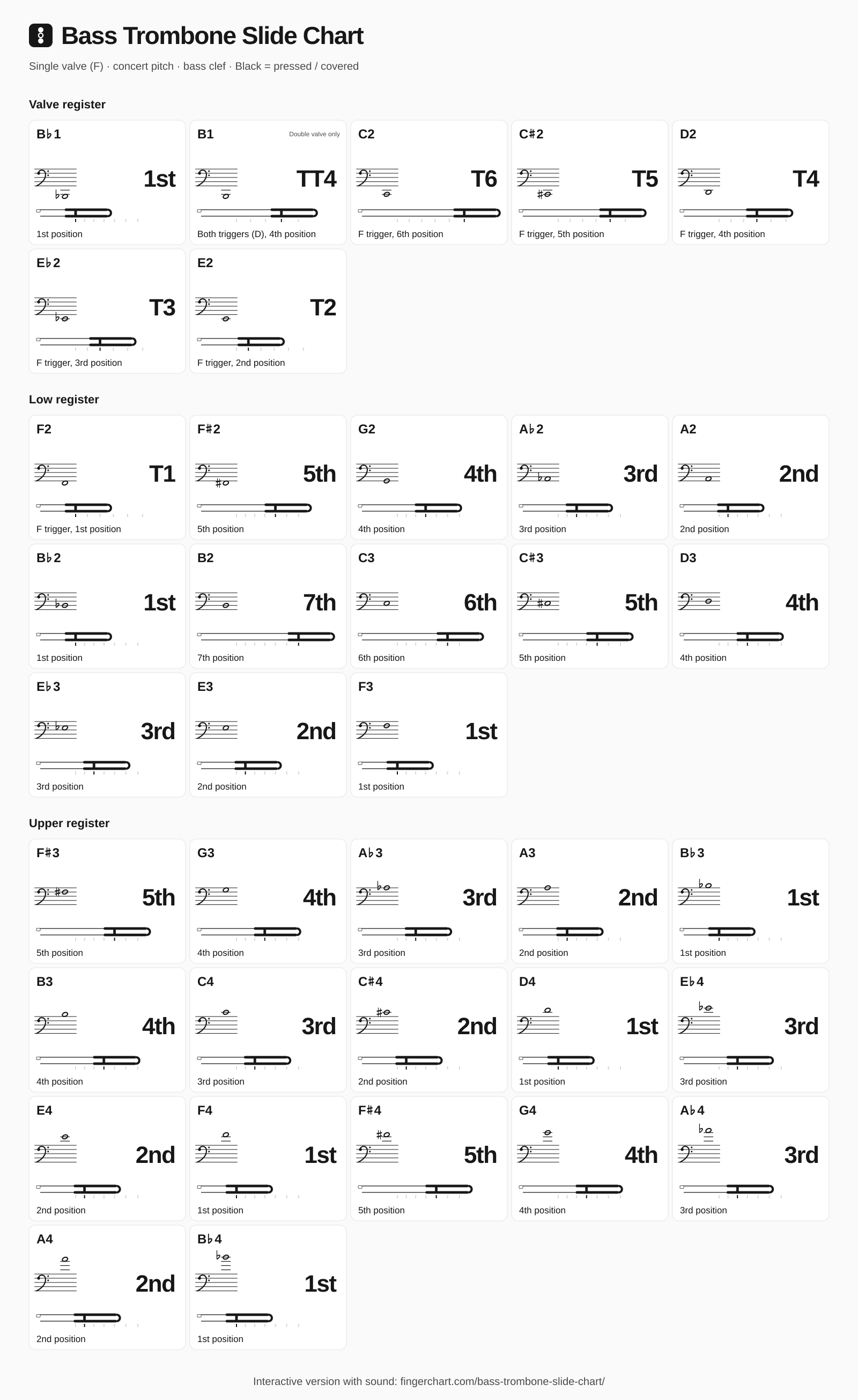
How to read this bass trombone slide chart
Each box shows one note in bass clef, the slide drawn at its position, and the position number. “T” means the F valve; “TT” means both valves. So “T3” is the F valve in 3rd position, and “TT1” is both valves with the slide all the way in.
The chart shows the single-valve fingering first. Where a double-valve bass trombone does it differently, a second line shows it, for example “Double valve: TT1” on low D.
Single valve vs double valve
A single-valve bass trombone has one F valve, like an F-attachment tenor with a bigger bore and bell. It covers everything down to low C, but low C sits at a long 6th position with the valve, and low B is missing.
A double-valve bass trombone adds a second valve, usually tuned to G♭ (some are tuned to G). Pressing both valves puts the instrument in D. That fills in low B and gives you low C, C♯ and D in short positions instead of long reaches.
The low register in valve positions
| Note | Single valve | Double valve |
|---|---|---|
| F | T1 | T1 |
| E | T2 | T2 |
| E♭ | T3 | T3 |
| D | T4 | TT1 |
| D♭ | T5 | TT2 |
| C | T6 | TT3 |
| B | Not available | TT4 |
| B♭ (pedal) | 1 | 1 |
Positions with both valves are approximate: they depend on how your valve slides are set, so tune them with a tuner and adjust.
Using the F valve above the staff
The F valve isn’t only for low notes. T1 for C3 and T2 for B2 save the long reaches to 6th and 7th position, and they make fast passages around the bass clef staff far smoother. Practice switching between 6th and T1 so both feel natural.
Teachers: link to this chart
Add it to your band website, class page or library guide. It is free to link to, with no sign-up.
Bass Trombone Slide Chart FAQ
Are bass trombone positions the same as tenor trombone?
Yes. A bass trombone is pitched in B♭ like a tenor, so the seven slide positions are the same. The difference is the valves: every bass trombone has an F valve, and most have a second valve that opens up the low register.
What does T and TT mean on a bass trombone chart?
T means press the F valve (the trigger under your left thumb). TT means press both valves together. On an independent F and G♭ bass trombone, both valves put the instrument in D, so low D is TT in 1st position.
Why can't I play low B on my trombone?
With only an F valve there is a gap: low B (B1) sits between pedal B♭ in 1st position and low C at the end of the F-valve slide. A second valve fills that gap, which is why double-valve bass trombones exist. On this chart, low B shows as double valve only.
What is the difference between independent and dependent valves?
On an independent bass trombone each valve works on its own and both together give D. On a dependent instrument the second valve only works when the F valve is down. The positions with both valves are the same idea, but the exact spots depend on how your second valve is tuned.
What is the lowest note on a bass trombone?
Pedal B♭ (B♭1) in 1st position is the bottom of this chart. Pedal tones continue lower, and good players can reach pedal F and below with the valves.
Should a beginner start on bass trombone?
Most players start on tenor trombone and move to bass once they have a steady sound and know the seven positions. Everything you learn on tenor carries over directly.
Related charts
Last updated .How we verify fingerings