Trumpet Fingering Chart
This trumpet fingering chart shows the valves for every note on B♭ trumpet, from low F♯ to high C and up to double G. Tap a note to see which valves to press and hear how it should sound.
Written note
Sounds B♭3 (concert)
Open (no valves)
Low C, usually the first note a trumpet player learns. Relaxed, open sound.
Keyboard of every note on this chart. Use the note list or arrow keys instead if you prefer.
Instrument type
Notes shown
Note names
Options
Play a scale
Alternate fingerings for C4
None in common use. Use the main fingering above.
All trumpet fingerings (low F♯ to high C)
Every note on one page. Tap a note to hear it and load it into the tool above. Black means pressed or covered.
Low register (below the staff)F♯3–D4
Middle register (in the staff)E♭4–F5
- E♭4 / D♯4concert D♭42 + 3
- E4concert D41 + 2
- F4concert E♭41
- F♯4 / G♭4concert E42
- G4concert F4Open
- G♯4 / A♭4concert F♯42 + 3
- A4concert G41 + 2Alt: 3
- B♭4 / A♯4concert A♭41
- B4concert A42
- C5concert B♭4Open
- C♯5 / D♭5concert B41 + 2Alt: 3
- D5concert C51Alt: 1 + 3
- E♭5 / D♯5concert D♭52Alt: 2 + 3
- E5concert D5OpenAlt: 1 + 2
- F5concert E♭51
High register (above the staff)F♯5–C6
Above high CC♯6–G6
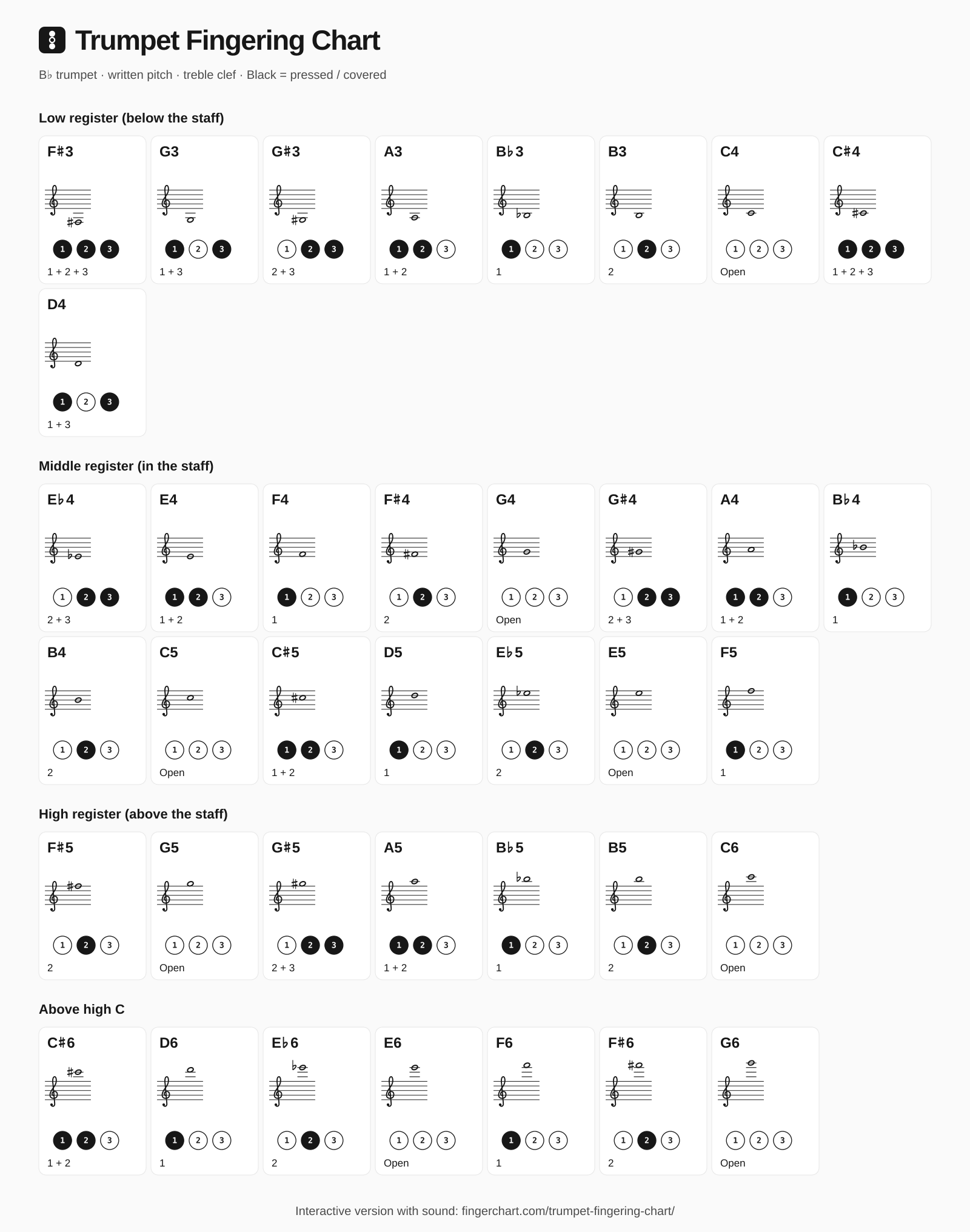
How to read this trumpet fingering chart
Each box shows one written note. The three circles are the valves as you look down on them: valve 1 is nearest your mouth, valve 3 is nearest the bell. Filled circles are pressed down. “Open” means no valves.
Notes are written as your band music shows them. A B♭ trumpet sounds a whole step lower than written, so written C comes out as a concert B♭. The small “concert” label in each box tells you what the note sounds like on the piano, which helps when you tune with the band.
Black-key notes have two names, like F♯ and G♭. They are the same note with the same fingering, so the chart lists both.
Trumpet fingerings for beginners: the first 8 notes
Most beginning trumpet players learn the concert B♭ scale first. On trumpet that is written C to C:
| Note | Valves | Tip |
|---|---|---|
| Low C (C4) | Open | Relaxed, open sound |
| D | 1 + 3 | Push the 3rd valve slide out a little |
| E | 1 + 2 | |
| F | 1 | |
| G | Open | Same as low C, faster air |
| A | 1 + 2 | Same as E, one partial higher |
| B | 2 | |
| C (third space) | Open | Keep the corners firm |
Play each note long and steady before moving on. If two notes share a fingering (C and G, E and A), practice slurring between them without moving your fingers. That is the fastest way to learn to control partials.
Trumpet high notes above the staff
Above the staff, the partials get closer together, so many notes have more than one possible fingering and it gets easier to “miss” and hit a neighbor. A few habits help:
- Use air, not pressure. Pressing the mouthpiece harder into your lips tires you out and closes off the sound. Faster, narrower air is what raises the pitch.
- Hear the note first. Tap the note in the chart above and listen before you play it.
- Build up slowly. Lip slurs on open (C–G–C–E–G) and on 2nd valve help more than trying high C over and over.
High C (C6) is open. Above it, D is 1, E♭ is 2, E is open and F is 1. Those fingerings are standard, but notes this high depend heavily on the player and the horn.
Alternate fingerings and when to use them
Alternate fingerings play the same note on a different valve combination. Turn on Alternates in the tool to see them for any note. The common ones:
- A and C♯ on 3rd valve instead of 1+2. Useful for fast passages and trills where 1+2 is awkward.
- D on 1+3 (fourth line) and G on 1+3 (above the staff). These sit on a higher partial and are mainly used for trills and lip slurs.
- Top-space E on 1+2. Open E is often flat; 1+2 can be better in tune and is easier for some trills.
Use the regular fingering by default. Reach for an alternate when it fixes a tuning problem or makes a fast passage cleaner, and check with your director if you are unsure.
B♭ vs C trumpet
Almost every school band trumpet is in B♭. A C trumpet is a little smaller and sounds exactly as written, so orchestral players often use it. The fingerings for each written note are the same on both. What changes is the sound: written C on a C trumpet is a concert C, while on a B♭ trumpet it is a concert B♭.
Use the Instrument type switch in the tool to see the concert pitch for either trumpet.
Trumpet Fingering Chart FAQ
What is the fingering for high C on trumpet?
High C (written C6, two ledger lines above the staff) is played open, with no valves pressed. It uses the same fingering as low C, G in the staff and third-space C, so the difference comes from faster air and a firmer embouchure, not from the valves.
Why do some notes use the same fingering?
Each valve combination produces a whole series of notes called partials. With no valves down you can play C, G, C, E, G and high C just by changing your air speed and lip tension. That is why the chart shows the same fingering several times.
What notes should a beginner trumpet player learn first?
Most band books start with written C, D, E, F and G (open, 1+3, 1+2, 1 and open), which is the start of the concert B♭ scale. Switch the tool to Beginner view to see just those first notes, then add A, B and third-space C.
What does 'open' mean on a trumpet chart?
Open means no valves are pressed. On a B♭ trumpet the open notes are low C, G in the staff, third-space C, top-space E, G above the staff and high C.
Why are low D and low C♯ out of tune on my trumpet?
The 1+3 and 1+2+3 combinations are naturally sharp. Push the third valve slide out with your left ring finger when you play low D, C♯, G and F♯ below the staff. Your band director can help you find how far.
Do cornet and flugelhorn use the same fingerings as trumpet?
Yes. B♭ cornet and B♭ flugelhorn read the same written notes with the same three-valve fingerings as B♭ trumpet, so this chart works for them too. A few flugelhorns have a fourth valve that adds extra low options.
Related charts
Last updated .How we verify fingerings