Mellophone Fingering Chart
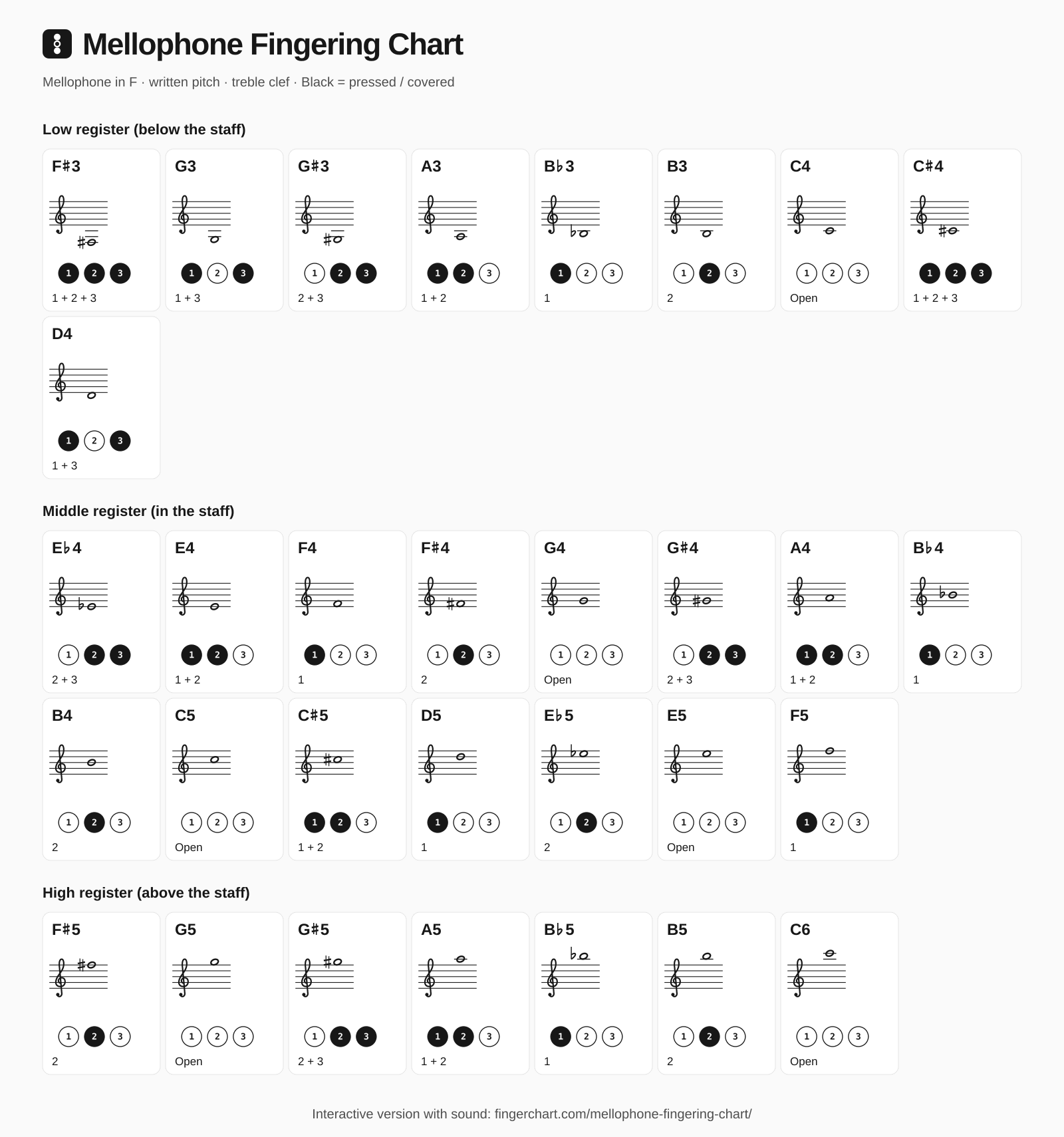
This mellophone fingering chart shows the valves for every written note on mellophone in F, from low F♯ below the staff to high C. Mellophone uses the same fingerings as trumpet. Tap a note to see which valves to press and hear how it sounds, or download the printable finger chart as a free PDF.
Written note
Sounds F4 (concert)
Open (no valves)
Third-space C, played open. Keep the air steady and the corners of the mouth firm.
Keyboard of every note on this chart. Use the note list or arrow keys instead if you prefer.
Notes shown
Note names
Options
Play a scale
Alternate fingerings for C5
None in common use. Use the main fingering above.
All mellophone fingerings (low F♯ to high C)
Every note on one page. Tap a note to hear it and load it into the tool above. Black means pressed or covered.
Low register (below the staff)F♯3–D4
Middle register (in the staff)E♭4–F5
- E♭4 / D♯4concert A♭32 + 3
- E4concert A31 + 2
- F4concert B♭31
- F♯4 / G♭4concert B32
- G4concert C4Open
- G♯4 / A♭4concert C♯42 + 3
- A4concert D41 + 2Alt: 3
- B♭4 / A♯4concert E♭41
- B4concert E42
- C5concert F4Open
- C♯5 / D♭5concert F♯41 + 2Alt: 3
- D5concert G41Alt: 1 + 3
- E♭5 / D♯5concert A♭42Alt: 2 + 3
- E5concert A4OpenAlt: 1 + 2
- F5concert B♭41
High register (above the staff)F♯5–C6
How to read this mellophone fingering chart
Each box shows one written note from your mellophone part. The three circles are the valves: valve 1 is under your first finger, valve 3 under your ring finger. Filled circles are pressed down. “Open” means no valves.
Mellophone music is written in F, like French horn music. A mellophone in F sounds a perfect fifth lower than written, so written C comes out as concert F. The small “concert” label in each box shows the piano note, which helps when you tune with the band.
Mellophone fingerings are trumpet fingerings
The mellophone’s open notes fall on the same written notes as a trumpet’s: C, G, C, E, G and high C. Every valve combination lowers those notes by the same amount, so each written note uses the same valves on mellophone and trumpet. A trumpet player can pick up a mellophone part and finger it right away.
What changes is the sound. The same written note sounds a perfect fourth lower on mellophone than on B♭ trumpet, and the larger bell gives a rounder, warmer tone, somewhere between a trumpet and a horn.
Mellophone notes for beginners
The concert B♭ scale is a good first scale, because most bands warm up on it. For mellophone in F it is written F to F:
| Note | Where on the staff | Valves |
|---|---|---|
| F | First space | 1 |
| G | Second line | Open |
| A | Second space | 1 + 2 |
| B♭ | Middle line (flat) | 1 |
| C | Third space | Open |
| D | Fourth line | 1 |
| E | Top space | Open |
| F | Top line | 1 |
F, B♭ and the top-line F all use the first valve, and G, C and E are all open. Your air and lips choose which one sounds, so practice slurring between notes that share a fingering without moving your fingers.
Switching from French horn to mellophone
In marching band the mellophone usually plays the horn parts, because a horn’s bell points backward and is hard to hear on the field. Horn players see the same written notes and hear the same concert pitches, but a few things change:
- Different fingerings. The mellophone is half the length of an F horn, so it plays each written note on a lower partial. Some fingerings match the F horn and many don’t.
- Right hand on the valves. The left hand holds the instrument instead of playing the valves.
- The partials are farther apart. Notes are easier to center than on horn, but each valve combination covers fewer notes, so you change fingerings more often.
Start with the open notes (written C, G, C and E) and the concert B♭ scale above, then fill in the rest from the chart.
Mellophone notes that play out of tune
Every three-valve instrument has a few notes that lean sharp or flat. On mellophone, watch these:
- Low D and low C♯ (1 + 3 and 1 + 2 + 3) are sharp, as are low G and F♯ below the staff. Lip them down, and use a tuner to learn how far.
- Top-space E (open) tends to be flat. The 1 + 2 alternate is often better in tune. Turn on Alternates in the tool to see it.
- C♯ in the third space (1 + 2) is slightly sharp. The 3rd valve alternate can help in fast passages.
Teachers: link to this chart
Add it to your band website, class page or library guide. It is free to link to, with no sign-up.
Mellophone Fingering Chart FAQ
Is mellophone fingering the same as trumpet?
Yes. For every written note, a mellophone in F uses the same three-valve fingering as a trumpet. Only the sound changes: the same written note comes out a perfect fourth lower on mellophone than on B♭ trumpet. If you can read a trumpet chart, you can already finger mellophone parts.
Is mellophone fingering the same as French horn?
No. Mellophone and F horn read the same parts written in F and sound the same pitches, but the mellophone is half the length of an F horn, so it plays each note on a different partial. A few fingerings match and many don't, so horn players need to learn the mellophone (trumpet) fingerings.
What key is the mellophone in?
Modern band and marching mellophones are in F. Written C sounds concert F, a perfect fifth lower, the same transposition as French horn. Each box on the chart shows the concert note too, so you can match the band when your director names a concert pitch.
Which hand plays the valves on a mellophone?
The right hand, the same as on a trumpet. Your right index, middle and ring fingers sit on valves 1, 2 and 3, and the left hand holds the instrument. That is the opposite of French horn, where the left hand plays the valves.
What is the range of the mellophone?
This chart runs from written F♯ below the staff up to high C two ledger lines above it. That covers almost every band and marching mellophone part. The lowest notes use 1 + 2 + 3 and 1 + 3, which play sharp, so check them with a tuner.
Do E♭ mellophones and alto horns use the same fingerings?
Yes, for the written notes. Older concert mellophones and alto horns in E♭ use the same three-valve fingering for each written note. They sound a major sixth lower than written instead of a fifth, so the concert labels on this chart won't match them.
Is there a printable mellophone finger chart?
Yes. The Download PDF button above the chart gives you a free one-page mellophone fingering chart with every note on it. Print it for your music stand, practice binder or marching flip folder.
Related charts
Last updated .How we verify fingerings