Bassoon Fingering Chart
This bassoon fingering chart shows every bassoon note from low B♭ to the D above middle C, with the whisper key, half-hole and flick keys. Tap a note to see the fingering and hear how it should sound.
Note
Whisper key, left hand 1-2-3 and right hand 1-2-3
All six fingers plus the whisper key. A good first note.
Keyboard of every note on this chart. Use the note list or arrow keys instead if you prefer.
Notes shown
Options
Play a scale
Alternate fingerings for G2
None in common use. Use the main fingering above.
All bassoon fingerings (low B♭ to D above middle C)
Every note on one page. Tap a note to hear it and load it into the tool above. Black means pressed or covered.
Low register (thumb keys)B♭1–F♯2
- B♭1 / A♯1Whisper key, left hand 1-2-3, right hand 1-2-3, left thumb low B♭ key, right thumb E key and right pinky F keyBeing checked
- B1Whisper key, left hand 1-2-3, right hand 1-2-3, left thumb low C key, left pinky C♯ key, right thumb E key and right pinky F keyBeing checked
- C2Whisper key, left hand 1-2-3, right hand 1-2-3, left thumb low C key, right thumb E key and right pinky F keyBeing checked
- C♯2 / D♭2Whisper key, left hand 1-2-3, right hand 1-2-3, left thumb low C key, left pinky C♯ key, right thumb E key and right pinky F keyBeing checked
- D2Whisper key, left hand 1-2-3, right hand 1-2-3, left thumb low D key, right thumb E key and right pinky F keyBeing checked
- E♭2 / D♯2Whisper key, left hand 1-2-3, right hand 1-2-3, left thumb low D key, left pinky E♭ key, right thumb E key and right pinky F keyBeing checked
- E2Whisper key, left hand 1-2-3, right hand 1-2-3, right thumb E key and right pinky F keyBeing checked
- F2Whisper key, left hand 1-2-3, right hand 1-2-3 and right pinky F key
- F♯2 / G♭2Whisper key, left hand 1-2-3, right hand 1-2-3 and right thumb F♯ keyAlt: Whisper key, left hand 1-2-3, right hand 1-2-3, right pinky F key and right thumb F♯ keyBeing checked
Middle registerG2–F♯3
- G2Whisper key, left hand 1-2-3 and right hand 1-2-3
- A♭2 / G♯2Whisper key, left hand 1-2-3, right hand 1-2-3 and right pinky A♭ keyAlt: Whisper key, left hand 1-2-3, right hand 1-2-3 and right thumb A♭ key
- A2Whisper key, left hand 1-2-3 and right hand 1-2
- B♭2 / A♯2Whisper key, left hand 1-2-3, right hand 1 and right thumb B♭ key
- B2Whisper key, left hand 1-2-3 and right hand 1
- C3Whisper key and left hand 1-2-3
- C♯3 / D♭3Whisper key, left hand 1-2-3 and left pinky C♯ keyBeing checked
- D3Whisper key and left hand 1-2
- E♭3 / D♯3Whisper key, left hand 1-2 and left pinky E♭ keyBeing checked
- E3Whisper key and left hand 1
- F3Whisper keyBeing checked
- F♯3 / G♭3Whisper key, left hand 1, right hand 1-2-3 and right thumb F♯ keyBeing checked
Upper register (half-hole and flick keys)G3–D4
- G3Half-hole, left hand 2-3 and right hand 1-2-3Being checked
- A♭3 / G♯3Half-hole, left hand 2-3, right hand 1-2-3 and right pinky A♭ keyBeing checked
- A3Half-hole, left hand 2-3, right hand 1-2 and high A flick keyBeing checked
- B♭3 / A♯3Left hand 1-2-3, right hand 1, right thumb B♭ key and high A flick keyBeing checked
- B3Left hand 1-2-3, right hand 1 and high A flick keyBeing checked
- C4Left hand 1-2-3 and high C flick keyBeing checked
- C♯4 / D♭4Left hand 1-2, right hand 1-2-3 and high C flick keyBeing checked
- D4Left hand 1-2, right hand 1-2 and high D flick keyBeing checked
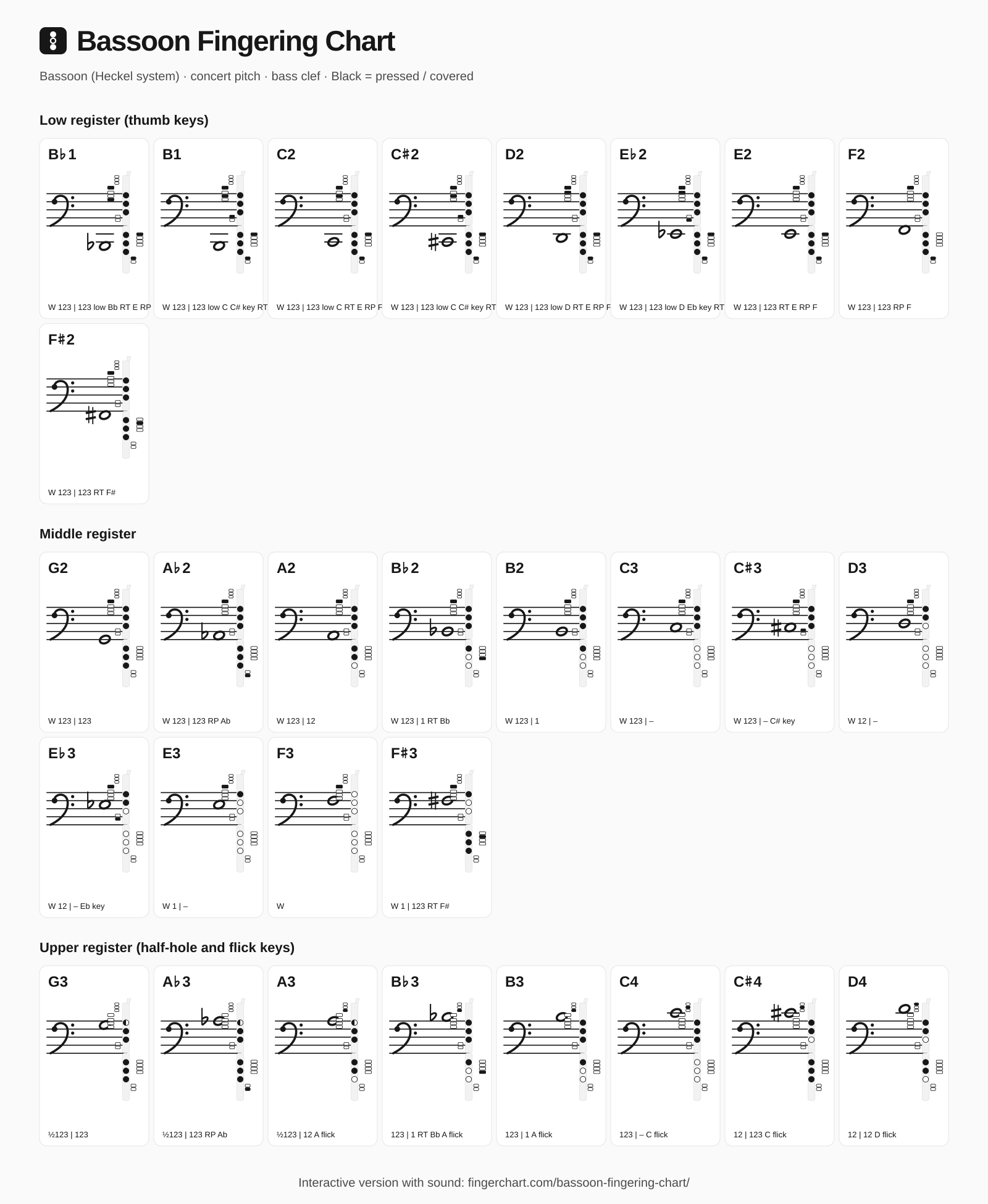
How to read this bassoon fingering chart
The diagram is a front view of the bassoon with the bocal at the top.
- Circles are the six finger holes, left hand on top. The top hole shows a half-hole when only its left half is filled.
- Left side: the left thumb keys. From top to bottom: the three flick keys (D, C, A), the whisper key (W), then low D, low C and low B♭. Further right are the left pinky C♯ and E♭ keys.
- Right side: the right thumb keys (E, F♯, A♭, B♭) and, below, the right pinky F and A♭ keys.
Bassoon reads bass clef at concert pitch. Higher parts sometimes use tenor clef; this chart writes everything in bass clef.
Many bassoon entries are marked Being checked while a bassoonist reviews them. Bassoon key work varies between makers and student models, so ask your teacher about any key that is missing or in a different spot.
Bassoon notes for beginners
| Note | Fingering |
|---|---|
| G (bottom line) | Whisper key, all six fingers |
| A | Whisper key, left 1-2-3, right 1-2 |
| B♭ | Whisper key, left 1-2-3, right 1 + right thumb B♭ |
| C | Whisper key, left 1-2-3 |
| D | Whisper key, left 1-2 |
| E | Whisper key, left 1 |
Bassoon high register and flick keys
Above F the whisper key comes off and the half-hole and flick keys take over. Tap the A flick for A, B♭ and B, and the C flick for C and C♯. Flick on the attack, then let go; holding the flick key changes the pitch. The chart shows the flick key that most players use for each note.
Bassoon Fingering Chart FAQ
What is the whisper key on a bassoon?
The whisper key (also called the pianissimo key) is pressed by the left thumb for most notes from the bottom of the instrument up to F on the fourth line of the bass staff. It closes a small vent so low and middle notes speak cleanly.
What are flick keys on the bassoon?
Flick keys are the small A, C and (on some bassoons) D keys on the wing joint. You tap one briefly with the left thumb as a note starts, which helps notes like A (top line), B♭, B and C speak without cracking.
What notes should a beginner bassoon player learn first?
Most beginners start on F, G and C in the bass staff, then fill in the low register. G (all six fingers plus the whisper key) and C (left hand only) are good starting notes.
What is the half-hole on a bassoon?
The left index finger hole can be half-covered by rolling the finger down. Half-holing helps G, A♭ and A at the top of the bass staff speak in the right octave.
How many keys does the left thumb press on the bassoon?
The left thumb works the whisper key, the low D, C and B♭ keys and the flick keys. That is why bassoon fingerings often start with the thumb.
Related charts
Last updated .How we verify fingerings