Clarinet Fingering Chart
This clarinet fingering chart shows every note on the B♭ clarinet, from low E through the break to the altissimo register. Tap a note to see which holes and keys to press and hear how it should sound.
Written note
Sounds F4 (concert)
Open: no keys or holes
Open G: nothing pressed. Keep your fingers hovering close to the holes.
Keyboard of every note on this chart. Use the note list or arrow keys instead if you prefer.
Notes shown
Note names
Options
Play a scale
Alternate fingerings for G4
None in common use. Use the main fingering above.
All clarinet fingerings (low E to altissimo)
Every note on one page. Tap a note to hear it and load it into the tool above. Black means pressed or covered.
Low (chalumeau) registerE3–F♯4
- E3concert D3Thumb hole, left hand 1-2-3, right hand 1-2-3 and left pinky E/B keyAlt: Thumb hole, left hand 1-2-3, right hand 1-2-3 and right pinky E/B key
- F3concert E♭3Thumb hole, left hand 1-2-3, right hand 1-2-3 and right pinky F/C keyAlt: Thumb hole, left hand 1-2-3, right hand 1-2-3 and left pinky F/C key
- F♯3 / G♭3concert E3Thumb hole, left hand 1-2-3, right hand 1-2-3 and left pinky F♯/C♯ keyAlt: Thumb hole, left hand 1-2-3, right hand 1-2-3 and right pinky F♯/C♯ key
- G3concert F3Thumb hole, left hand 1-2-3 and right hand 1-2-3
- G♯3 / A♭3concert F♯3Thumb hole, left hand 1-2-3, right hand 1-2-3 and right pinky A♭/E♭ key
- A3concert G3Thumb hole, left hand 1-2-3 and right hand 1-2
- B♭3 / A♯3concert A♭3Thumb hole, left hand 1-2-3 and right hand 1Being checked
- B3concert A3Thumb hole, left hand 1-2-3 and B/F♯ sliver keyBeing checked
- C4concert B♭3Thumb hole and left hand 1-2-3
- C♯4 / D♭4concert B3Thumb hole, left hand 1-2-3 and left pinky C♯/G♯ key
- D4concert C4Thumb hole and left hand 1-2
- E♭4 / D♯4concert D♭4Thumb hole, left hand 1 and E♭/B♭ sliver keyBeing checked
- E4concert D4Thumb hole and left hand 1
- F4concert E♭4Thumb hole
- F♯4 / G♭4concert E4Left hand 1
Throat tonesG4–B♭4
Upper (clarion) registerB4–C6
- B4concert A4Thumb hole, register key, left hand 1-2-3, right hand 1-2-3 and left pinky E/B keyAlt: Thumb hole, register key, left hand 1-2-3, right hand 1-2-3 and right pinky E/B key
- C5concert B♭4Thumb hole, register key, left hand 1-2-3, right hand 1-2-3 and right pinky F/C keyAlt: Thumb hole, register key, left hand 1-2-3, right hand 1-2-3 and left pinky F/C key
- C♯5 / D♭5concert B4Thumb hole, register key, left hand 1-2-3, right hand 1-2-3 and left pinky F♯/C♯ keyAlt: Thumb hole, register key, left hand 1-2-3, right hand 1-2-3 and right pinky F♯/C♯ key
- D5concert C5Thumb hole, register key, left hand 1-2-3 and right hand 1-2-3
- E♭5 / D♯5concert D♭5Thumb hole, register key, left hand 1-2-3, right hand 1-2-3 and right pinky A♭/E♭ key
- E5concert D5Thumb hole, register key, left hand 1-2-3 and right hand 1-2
- F5concert E♭5Thumb hole, register key, left hand 1-2-3 and right hand 1Being checked
- F♯5 / G♭5concert E5Thumb hole, register key, left hand 1-2-3 and B/F♯ sliver keyBeing checked
- G5concert F5Thumb hole, register key and left hand 1-2-3
- G♯5 / A♭5concert F♯5Thumb hole, register key, left hand 1-2-3 and left pinky C♯/G♯ key
- A5concert G5Thumb hole, register key and left hand 1-2
- B♭5 / A♯5concert A♭5Thumb hole, register key, left hand 1 and E♭/B♭ sliver keyBeing checked
- B5concert A5Thumb hole, register key and left hand 1
- C6concert B♭5Thumb hole and register key
Altissimo registerC♯6–G6
- C♯6 / D♭6concert B5Thumb hole, register key, left hand 2-3, right hand 1-2-3 and left pinky E/B keyBeing checked
- D6concert C6Thumb hole, register key, left hand 2-3, right hand 1-2 and right pinky A♭/E♭ keyBeing checked
- E♭6 / D♯6concert D♭6Thumb hole, register key, left hand 2-3, right hand 1-3 and right pinky A♭/E♭ keyBeing checked
- E6concert D6Thumb hole, register key, left hand 2-3, right hand 1 and right pinky A♭/E♭ keyBeing checked
- F6concert E♭6Thumb hole, register key, left hand 2, right hand 1 and right pinky A♭/E♭ keyBeing checked
- F♯6 / G♭6concert E6Thumb hole, register key, left hand 2, right hand 2 and right pinky A♭/E♭ keyBeing checked
- G6concert F6Thumb hole, register key, left hand 2, right hand 1-2 and right pinky A♭/E♭ keyBeing checked
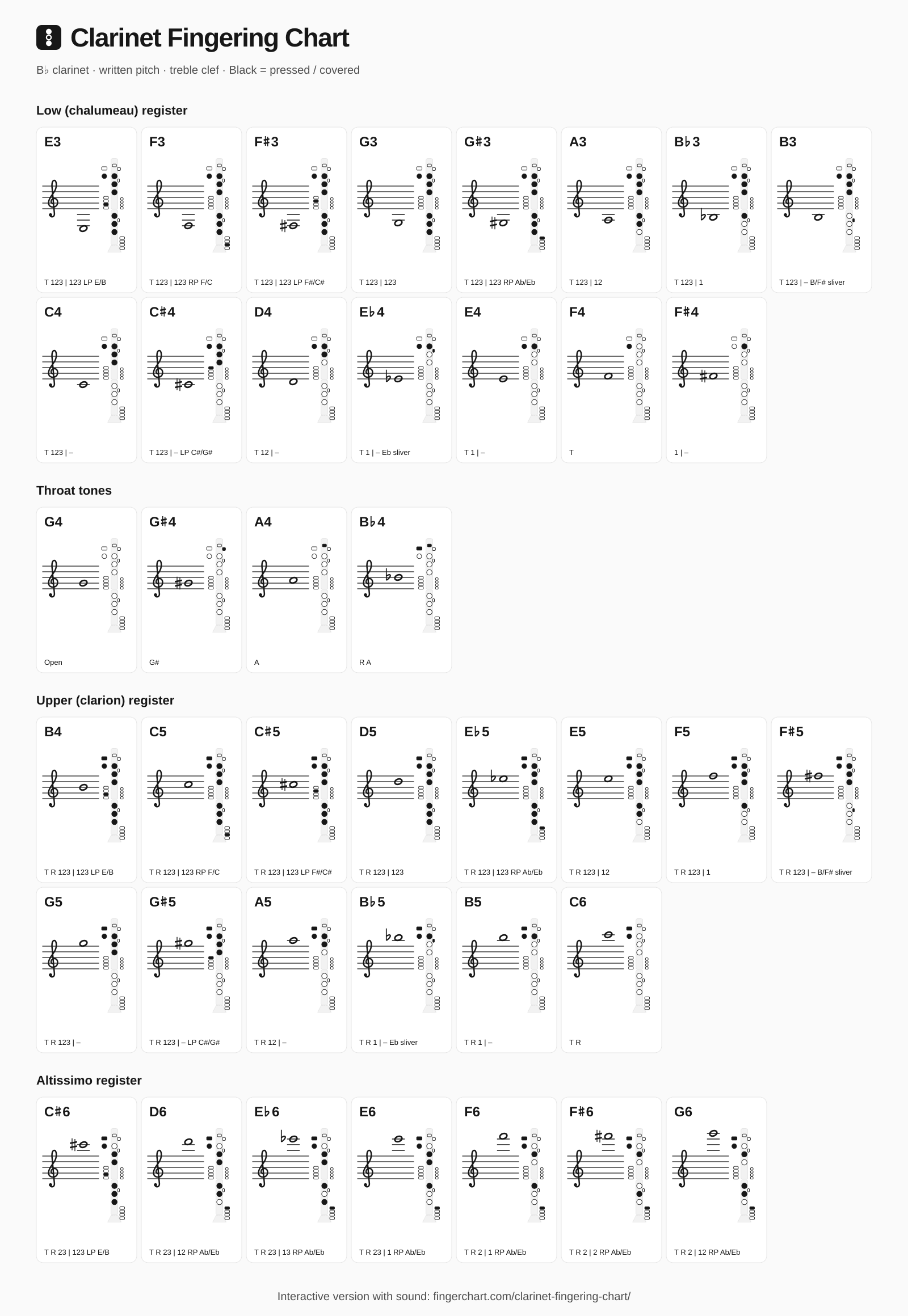
How to read this clarinet fingering chart
The diagram is a front view of the clarinet with the mouthpiece at the top.
- Circles are tone holes (left hand on top, right hand below). Filled means covered.
- The thumb hole (T) and register key (R) are on the back of the clarinet, so they are drawn on the left.
- Small keys: the A and G♯ keys sit above the left hand. The four side keys are on the right. The pinky keys are in two clusters, left hand above and right hand below.
- The text under each diagram spells out the fingering. “T R · 123 | 12” means thumb and register key, left fingers 1-2-3, right fingers 1-2.
Notes are written as your music shows them. A B♭ clarinet sounds a whole step lower than written, so the “concert” label shows the piano note.
Fingerings marked Being checked are waiting for review by a clarinetist. See how we verify fingerings.
Clarinet fingerings for beginners
Most beginners start in the middle of the low register and work outward:
| Note | Fingering | Tip |
|---|---|---|
| G (open G) | Nothing pressed | Fingers hover just above the holes |
| F | Thumb only | |
| E | Thumb + left 1 | |
| D | Thumb + left 1-2 | |
| C (middle C) | Thumb + left 1-2-3 | Cover every hole fully |
| A (throat A) | A key | Roll the first finger, don’t lift the hand |
Once those are steady, add the right hand going down (B♭, A, G, F, E) and the throat tones going up.
The break and the register key
The clarinet overblows a twelfth, not an octave. Add the register key to a low note and you get a note a twelfth higher: low E plus the register key is middle-line B, low F becomes C, and so on. That is why the upper (clarion) register uses the same fingers as the low register.
Crossing the break means moving from throat B♭ (almost nothing down) to B♮ (everything down plus the register key). To make it easier:
- Keep your right-hand fingers down or close to the holes while you play throat tones.
- Practice slurring low E to B with the register key only, keeping the air fast and steady.
- Don’t bite. Firm corners and fast air do the work.
Clarinet high notes and altissimo
The clarion register runs up to high C (C6), which is just the thumb and register key. Above that is the altissimo register. Most altissimo fingerings vent the left first finger and add the right pinky A♭/E♭ key.
Altissimo fingerings vary more than any other part of the clarinet. A note that works on one instrument, mouthpiece and reed can be sharp or flat on another. Treat the altissimo notes in this chart as a starting point and check them with your teacher. Some of them are still marked “Being checked.”
Pinky keys: left or right?
The little-finger keys follow a few rules:
- A♭/E♭ (low G♯ and E♭ above the staff) is right pinky only.
- C♯/G♯ (low C♯ and G♯ above the staff) is left pinky only.
- E/B, F/C and F♯/C♯ can be played with either pinky.
When two pinky notes come one after the other, switch hands so you never slide one finger from key to key. For example, play B with the left pinky, C with the right and C♯ with the left. Turn on Alternates in the tool to see both versions of each note.
Clarinet Fingering Chart FAQ
What is the fingering for high C on clarinet?
High C (written C6, two ledger lines above the staff) is the left thumb hole plus the register key, with every other finger off. It is the F fingering (thumb only) with the register key added.
What is the break on the clarinet?
The break is the jump between the throat tones (G, G♯, A and B♭ in the staff) and B♮ in the middle of the staff. You go from almost no fingers down to every finger plus the register key. Keep your right hand fingers resting near the holes on throat tones so the move is smaller.
Why does the clarinet have two fingerings for low E, F and F♯?
Those keys are doubled for the left and right little fingers. Switching hands lets you avoid sliding one pinky from key to key, for example B with the left pinky, then C with the right pinky.
What notes should a beginner clarinet player learn first?
Most band books start with E, F and G in the staff (thumb and first finger, thumb only, and open G), then D and C below them. Switch the tool to Beginner view to see just the low and middle notes.
Is bass clarinet fingering the same as clarinet?
Mostly. From low E up to high C, bass clarinet uses the same written fingerings as B♭ clarinet. Bass clarinets add low extension keys below E, and notes above high C use different fingerings.
Why does my clarinet squeak on low notes?
Usually a finger is not fully covering its hole. Use the pads of your fingers, not the tips, and check the left thumb and ring fingers first. A chipped reed or a leaky pad can also cause squeaks.
Related charts
Last updated .How we verify fingerings