Trombone Slide Chart
This trombone slide chart shows the slide position for every note on tenor trombone, from low E to high F. Tap a note to see where the slide goes and hear the note, then switch on the F attachment for trigger positions.
Note
1st position
Usually the first note a trombonist learns: slide all the way in, relaxed buzz.
Keyboard of every note on this chart. Use the note list or arrow keys instead if you prefer.
Instrument
Notes shown
Options
Play a scale
Alternate fingerings for B♭2
None in common use. Use the main fingering above.
All trombone slide positions (low E to high F)
Every note on one page. Tap a note to hear it and load it into the tool above. Black means pressed or covered.
Below low E (F attachment only)C2–E♭2
Low registerE2–E3
Middle registerF3–F4
High registerF♯4–F5
- F♯4 / G♭45th positionAlt: 3rd position
- G44th positionAlt: 2nd positionBeing checked
- A♭4 / G♯43rd position
- A42nd position
- B♭4 / A♯41st position
- B44th positionAlt: 2nd positionBeing checked
- C53rd positionAlt: 1st positionBeing checked
- C♯5 / D♭52nd position
- D51st positionAlt: 4th position
- E♭5 / D♯53rd position
- E52nd position
- F51st position
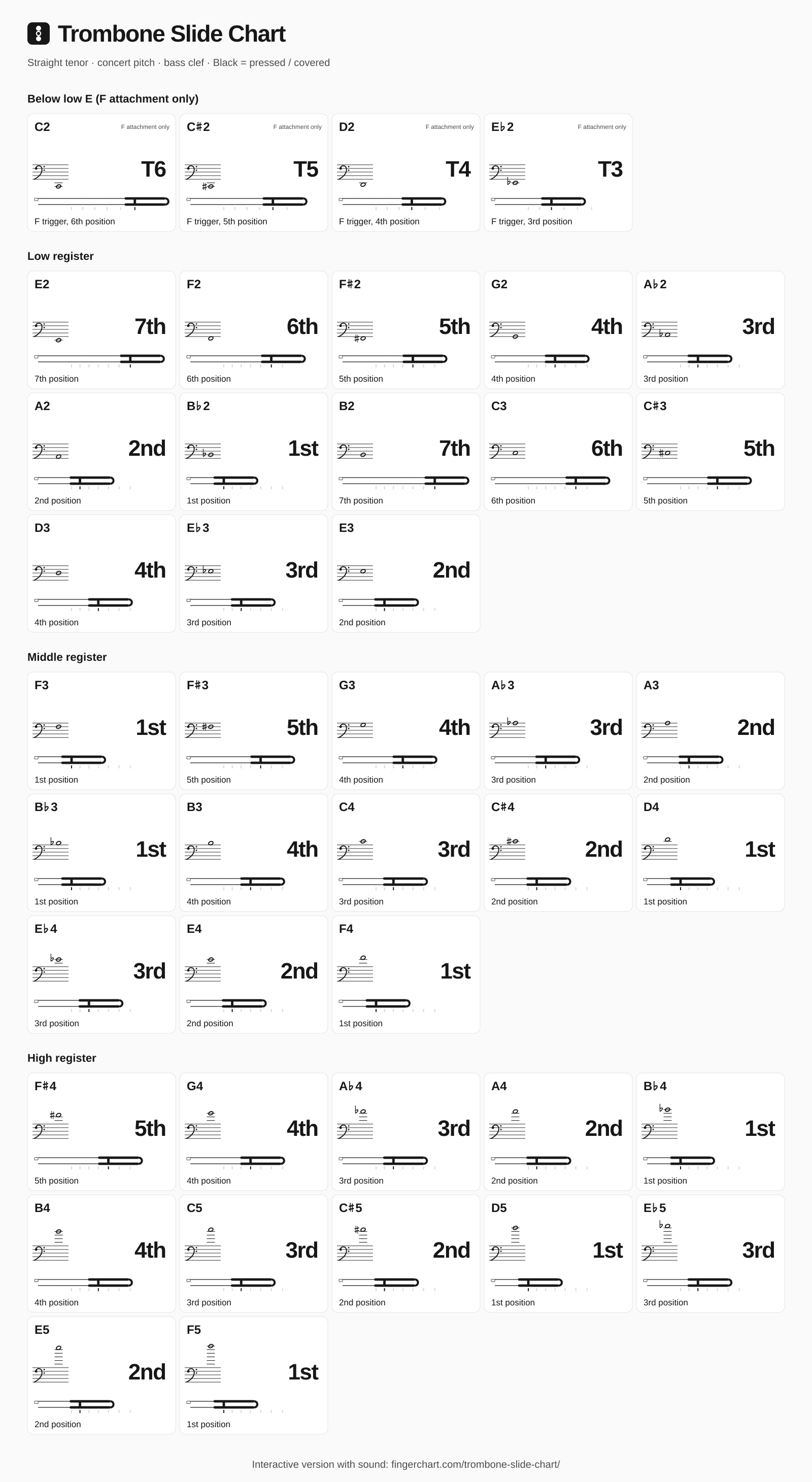
How to read this trombone slide chart
Each box shows one note as it appears in bass clef, the slide position number, and a small drawing of the slide. 1st position is the slide all the way in, 7th is fully out. Positions get a little further apart as you go out, because each one has to add a bit more tubing than the last.
Trombone reads at concert pitch, so the note in the chart is the note you hear. Notes with two names, like F♯ and G♭, are the same note in the same position.
Beginner trombone slide chart: the first 8 notes
Most band books start trombone players on the concert B♭ scale:
| Note | Position | Tip |
|---|---|---|
| B♭ (B♭2) | 1st | Slide all the way in, relaxed buzz |
| C | 6th | A long reach; keep your wrist loose |
| D | 4th | About at the bell |
| E♭ | 3rd | Just short of the bell |
| F | 1st | Faster air than low B♭ |
| G | 4th | Same position as D, higher partial |
| A | 2nd | |
| B♭ (B♭3) | 1st | Same position as low B♭, an octave up |
Move the slide quickly and tongue the next note only when the slide arrives. Slow, smooth slide motion between notes makes a smear; quick, light motion keeps the notes clean.
Trombone note chart: why notes share a position
In every position you can play several notes by changing your air speed and lip tension. In 1st position that is B♭2, F3, B♭3, D4, F4 and higher. This is why your trombone note sheet shows 1st position over and over. The note you get depends on your buzz, not the slide.
Higher up, the partials get closer together, so more notes appear in two positions and small slide adjustments matter more. Trust your ear and check with a tuner.
Alternate positions
Alternate positions play the same note in a different spot. Turn on Alternates in the tool to see them. The ones you will use most:
- D4 in 4th instead of 1st. Great next to G3 and F♯3, and often better in tune than 1st-position D, which runs sharp.
- F4 in 6th instead of 1st. Useful next to C3 or notes in 5th–7th position.
- B♭3 in 5th (slightly short). Handy in passages around C4 and D4.
- F♯4 in raised 3rd and G4 in raised 2nd. These sit on a partial that runs flat, so bring the slide in a little.
F attachment (F trigger)
An F attachment adds a valve, worked by your left thumb, that lowers the trombone by a fourth. Switch the tool to With F attachment to see trigger positions, marked T1, T2 and so on.
- Low C (C3): T1 instead of 6th. This is the most common reason to use the trigger.
- Low F (F2): T1 instead of 6th.
- B2 and E2: T2, a slightly long 2nd, instead of 7th.
- Below low E: the trigger fills in E♭2, D2, D♭2 and C2, which a straight tenor cannot play. These positions sit further out, and low C2 may need the F tuning slide pulled out.
Trigger positions are longer than normal positions with the same number, because the extra tubing makes each half step a bigger move.
Trombone Slide Chart FAQ
How many slide positions does a trombone have?
Seven. 1st position has the slide all the way in and each position after that is one half step lower. 7th position is at full arm's length. With an F attachment you get extra trigger positions on top of those seven.
Where is 3rd and 4th position on a trombone?
On most tenor trombones 3rd position is just short of the bell, and 4th position lines up with the edge of the bell. Use those landmarks, then let your ear adjust. Every trombone is slightly different.
What position is middle C on trombone?
Middle C (C4, the first ledger line above the bass clef staff) is in 3rd position. If your trombone has an F attachment, you can also play it with the trigger in 1st position.
Why does the same note have two slide positions?
Each position plays a series of notes called partials. Some notes, like D4 and F4 just above the bass clef staff, appear in two positions. Players use the alternate to avoid long slide jumps, for example D4 in 4th next to G3 in 4th.
What does the F attachment on a trombone do?
The trigger adds extra tubing that lowers the trombone by a fourth, to F. That puts low C in 1st position instead of 6th, and fills the gap between low E and the pedal notes. Trigger positions sit a little further out than normal positions.
Does a beginner need a trombone with an F attachment?
No. Most beginners start on a straight tenor trombone, which plays everything in a school band book. An F attachment helps later with low notes and fast passages that would need 6th or 7th position.
What is the trombone slide position for high F?
Both Fs above the bass clef staff are in 1st position: F4 (just above the second ledger line) and high F (F5). F4 also has an alternate in 6th position.
Related charts
Last updated .How we verify fingerings