Saxophone Fingering Chart
This saxophone fingering chart works for alto, tenor, bari and soprano sax: every note from low B♭ to high F, including palm keys and side keys. Tap a note to see the fingering and hear it on your sax.
Written note
Sounds B♭3 (concert)
Left hand 1-2-3
Left hand only. A common first note.
Keyboard of every note on this chart. Use the note list or arrow keys instead if you prefer.
Instrument type
Notes shown
Note names
Options
Play a scale
Alternate fingerings for G4
None in common use. Use the main fingering above.
All saxophone fingerings (low B♭ to high F♯)
Every note on one page. Tap a note to hear it and load it into the tool above. Black means pressed or covered.
Low registerA3–C♯5
- A3concert C3Left hand 1-2-3, right hand 1-2-3, left pinky low B♭ key and low A key (left thumb, bari only)Bari sax only
- B♭3 / A♯3concert D♭3Left hand 1-2-3, right hand 1-2-3 and left pinky low B♭ key
- B3concert D3Left hand 1-2-3, right hand 1-2-3 and left pinky low B key
- C4concert E♭3Left hand 1-2-3, right hand 1-2-3 and right pinky low C key
- C♯4 / D♭4concert E3Left hand 1-2-3, right hand 1-2-3, left pinky low C♯ key and right pinky low C key
- D4concert F3Left hand 1-2-3 and right hand 1-2-3
- E♭4 / D♯4concert G♭3Left hand 1-2-3, right hand 1-2-3 and right pinky low E♭ key
- E4concert G3Left hand 1-2-3 and right hand 1-2
- F4concert A♭3Left hand 1-2-3 and right hand 1
- F♯4 / G♭4concert A3Left hand 1-2-3 and right hand 2
- G4concert B♭3Left hand 1-2-3
- G♯4 / A♭4concert B3Left hand 1-2-3 and left pinky G♯ key
- A4concert C4Left hand 1-2
- B♭4 / A♯4concert D♭4Left hand 1 and bis B♭ keyAlt: Left hand 1 and right hand 1; Left hand 1 and side B♭ key
- B4concert D4Left hand 1
- C5concert E♭4Left hand 2Alt: Left hand 1 and side C key
- C♯5 / D♭5concert E4Open: no keys or holes
Upper register (octave key)D5–C♯6
- D5concert F4Octave key, left hand 1-2-3 and right hand 1-2-3
- E♭5 / D♯5concert G♭4Octave key, left hand 1-2-3, right hand 1-2-3 and right pinky low E♭ key
- E5concert G4Octave key, left hand 1-2-3 and right hand 1-2
- F5concert A♭4Octave key, left hand 1-2-3 and right hand 1
- F♯5 / G♭5concert A4Octave key, left hand 1-2-3 and right hand 2
- G5concert B♭4Octave key and left hand 1-2-3
- G♯5 / A♭5concert B4Octave key, left hand 1-2-3 and left pinky G♯ key
- A5concert C5Octave key and left hand 1-2
- B♭5 / A♯5concert D♭5Octave key, left hand 1 and bis B♭ keyAlt: Octave key, left hand 1 and right hand 1; Octave key, left hand 1 and side B♭ key
- B5concert D5Octave key and left hand 1
- C6concert E♭5Octave key and left hand 2Alt: Octave key, left hand 1 and side C key
- C♯6 / D♭6concert E5Octave key
Palm keys and high F♯D6–F♯6
- D6concert F5Octave key and palm D key
- E♭6 / D♯6concert G♭5Octave key, palm D key and palm E♭ key
- E6concert G5Octave key, palm D key, palm E♭ key and side high E key
- F6concert A♭5Octave key, palm D key, palm E♭ key, palm F key and side high E key
- F♯6 / G♭6concert A5Octave key, palm D key, palm E♭ key, palm F key, side high E key and high F♯ keyBeing checked
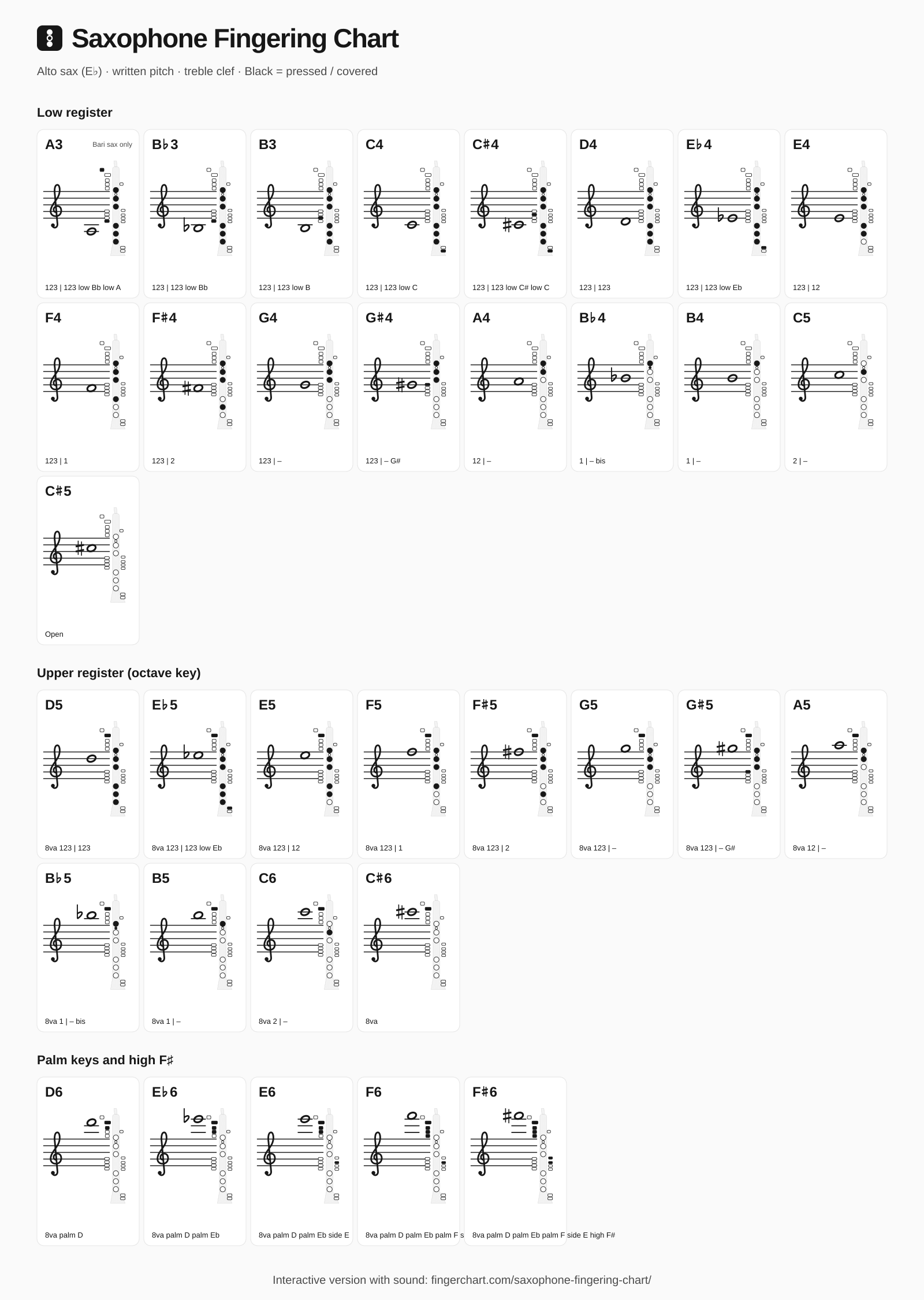
How to read this saxophone fingering chart
The diagram shows the front of the sax with the neck at the top.
- Circles are the main pearl keys: left hand 1-2-3 on top, right hand 1-2-3 below. The tiny circle between left 1 and 2 is the bis key.
- The octave key (marked 8) is under the left thumb, drawn on the left.
- Left side: palm keys (high D, E♭, F) at the top, then the left pinky table (G♯, low C♯, low B, low B♭).
- Right side: the side keys (high F♯, high E, side C, side B♭) and the right pinky keys (low E♭ and low C).
Alto sax notes for beginners
| Note | Fingering |
|---|---|
| B | Left 1 |
| A | Left 1-2 |
| G | Left 1-2-3 |
| C | Left 2 |
| F | Left 1-2-3, right 1 |
| D (low) | All six fingers |
Notes from D in the staff and up use the octave key with the same fingers as the octave below.
Alto, tenor, bari and soprano sax
Saxophone parts are written so every sax shares one fingering chart. The written note and the fingering stay the same; the sound is transposed:
| Sax | Key | Written C sounds |
|---|---|---|
| Soprano | B♭ | B♭, a whole step lower |
| Alto | E♭ | E♭, a major sixth lower |
| Tenor | B♭ | B♭, an octave and a whole step lower |
| Bari | E♭ | E♭, an octave and a sixth lower |
Palm keys and side keys
High D, E♭ and F use the left-hand palm keys plus the octave key. High E adds the right-hand side E key. The side C and side B♭ keys give alternate fingerings for C and B♭ that are smoother in some passages. Turn on Alternates to see them.
Saxophone Fingering Chart FAQ
Is the alto saxophone fingering chart the same as tenor?
Yes. Alto, tenor, baritone and soprano saxes all use the same fingering for the same written note. Only the sound changes: alto sounds a sixth lower than written, tenor a ninth lower. Switch the tool between them to hear the difference.
What are the alto sax notes for beginners?
Most band books start with B (left 1), A (left 1-2) and G (left 1-2-3), then C, F and the low notes. The Beginner view shows the first notes in the low register.
What are the palm keys on a saxophone?
The three palm keys under your left hand play high D, E♭ and F, together with the octave key. High E and F also use the side high-E key worked by the right hand.
What is the bis key on a saxophone?
The bis key is the small key between the first and second left-hand keys. Pressing it with the first finger along with the B key gives B♭. It is the easiest B♭ in most keys.
What is the lowest note on a bari sax?
Most modern baritone saxes go down to low A, using the low B♭ fingering plus a low A key worked by the left thumb. Older and some student bari saxes stop at low B♭.
What is altissimo on the saxophone?
Altissimo is the range above high F (or F♯). It uses special fingerings and voicing, and the fingerings change from sax to sax. Get comfortable with the full normal range first.
Related charts
Last updated .How we verify fingerings